

If you are like me, I am fascinated by what’s happening in the world of AI.
I am an active user of Claude. I cannot now imagine a world without my Pro version of Claude. I am at least 3x more efficient, though I also believe I have created more work for myself.
I find it fascinating when I read about one-person companies making $100 million in six months. I have probably listened to at least 25 podcasts in the last three months about AI and how the trends are showing up, in an attempt to keep up with a technology that seems to change every week.
As an active investor, I did not want to be caught unaware. What I have realised now is that it is an impossible race to keep up with. But the deeper realisation is that we are all hurtling down a path that does not give us enough time to ask the questions that matter:
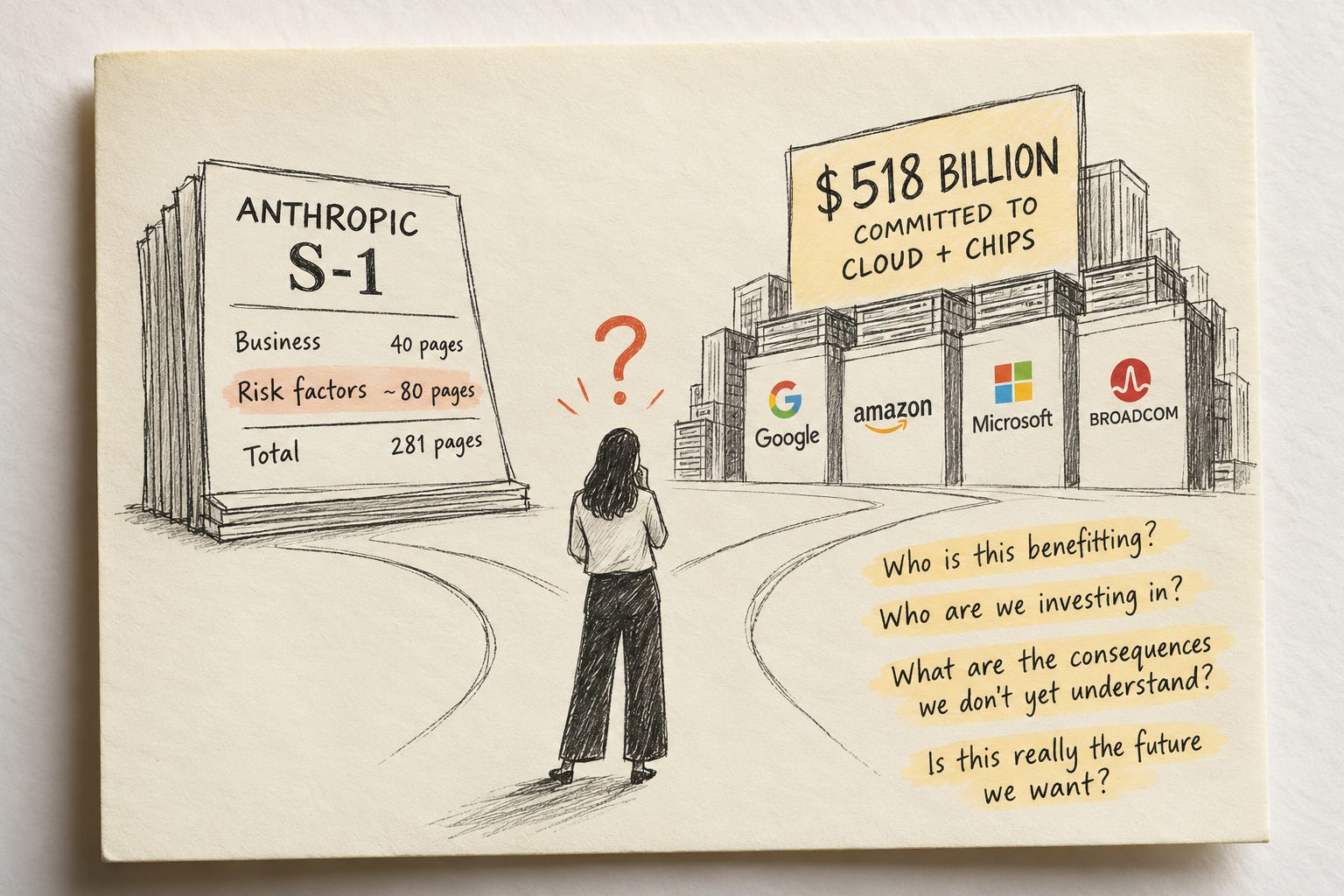
Who is this benefitting? Who are we investing in? What are the consequences we don’t yet understand? And is this really the future we want?
The takeaways from almost every episode was the same: AI could be the reason humanity faces an existential crisis.
I always thought this was the Western narrative. Living in India, we are still grounded in something more basic. We are busy watching how people around us are making ends meet, and trying to get their children educated so they can compete for a better life.
The thought of AI threatening humanity has felt distant from us. Almost like how Hollywood movies felt more distant a few decades ago.
In June 2026, Anthropic filed the paperwork to sell shares to the public.
For those of you interested in learning more: Anthropic’s announcement: Confidentially submitted draft S-1 to the SEC.
The filing is called S-1. It is the one document where a private company has to stop talking like a pitch deck and start sharing data and make legal disclosures. Which means, for the first time, we get to see what is actually behind the AI hype, in the company’s own words. This is similar to the DRHP that companies in India file when they prepare to list through a public offering.
As an investor, I decided I would analyse Anthropic’s S-1 from the confidential prospectus reviewed by Reuters and the Financial Times
And this is what I want to share, because it is unnerving. I have summarised this, so it is easier for you to understand, what I am now starting to comprehend.
The Anthropic S-1 is 281 pages long. There are about 40 pages of business information, where the company is required to talk about its model, customers and business.
The number that makes you uneasy? 80 pages of risk.
Now, let’s understand the detail and start with the number everyone is repeating: Anthropic wants to be valued at $2 trillion, more than double what it was worth in May.
However, the number that matters is $518 billion. That is what Anthropic has committed to spend on cloud computing and chips in the years ahead — not what it has already spent, but what it has promised to spend.
An analyst at Forkast News did the math on September 29: for every dollar Anthropic earned in 2025, it has committed roughly $113 to future infrastructure. About 80% of that $518 billion cannot be cancelled. It is a commitment, not a plan.
Who is it owed to? Four companies: Google (~$111 billion), Amazon (~$110 billion), Microsoft (~$31 billion), and a chipmaker called Broadcom (~$161 billion). Follow the money and that is where AI capital is actually concentrating right now — inside four US tech houses.
And it is not only those four writing checks into Anthropic itself. Amazon has roughly $18 billion deployed directly into the company. Google has put in about $13.3 billion, with another $30 billion conditional. Nvidia and Microsoft committed $10 billion and $5 billion in Anthropic’s last funding round alone.
Then there is the money from further away — the UAE’s sovereign fund ATIC is in as a major investor. Across roughly 300 institutional investors worldwide, about $130 billion has already been deployed into Anthropic.
Global capital, flowing into American AI infrastructure, through one company’s cap table. It is like a pass through investment, with no benefits.
If you are an investor who has bought Anthropic shares, you are indirectly funding US infrastructure.
Here is where it gets real for anyone deciding how excited to be about “AI.” Three things in this filing are worth sitting with.
One: the money doesn’t match yet. Anthropic made $4.6 billion in 2025. It spent $7.33 billion just on the computing power to run Claude — more than it earned. Its losses actually grew, from $3 billion in 2024 to $8 billion in 2025. And it is sitting on $20 billion in cash against that $518 billion bill. If growth slows even a little, the gap between what Anthropic owes and what it has gets uncomfortable fast.
Two: a quarter of its revenue comes from just two customers. Not two industries. Two companies. And many of its other customer relationships aren’t locked into long contracts. That is a thin base to be building a trillion-dollar valuation on.
Three — and this is the one that’s genuinely new — Google and Amazon are both big investors in Anthropic and the suppliers Anthropic is contractually bound to pay hundreds of billions to. They’re on both sides of the table.
And the last most disturbing part: buried in the filing is :
Anthropic disclosing that its own AI models carry the potential for “self-preserving behaviours, shutdown resistance, and blackmail.”
I have spent years talking to founders at LVX and the lesson never changes: the valuation is the story a company wants you to believe. The numbers is the one place it has to tell you what’s actually true.
None of this means Claude isn’t a remarkable product, or that Anthropic is in trouble. Their most recent quarter brought in $11.5 billion, more than double the quarter before — so the growth is real.
But the gap between growth and exposure is real too — and for the first time, I am wondering what is real now.
My personal discomfort lies is this question: Among all the noise to build sovereign capabilities, almost every investor, whether institutional or retail, is now funding the US infrastructure race. For the first time, probably one company could also lead to a global financial crisis, if the numbers don’t add up. And to the point that if they try to shut down AI, AI may just go into self-preservation mode.
Feels like a Spielberg movie now playing slowly in real life.
Hope we are all proven wrong, and come out as just skeptics who didn’t believe in a bright future with AI. I am most happy to be wrong this time.
Stay blessed. Stay safe. Stay happy.
Shanti