


To all my friends on Substack: Your messages after posts, personal messages on some of the learnings you’ve had has been the encouragement for me to write a book, and publish it. Your support means a lot - sometimes we tend to underestimate the power of soft love and support. So my first public post is to you, before I share it to the rest of my network.
I grew up in Jamshedpur, where money meant fixed deposits, LIC policies and wedding gold. Nobody around me called any of it a bet, but it was one. Refusing to bet is also a bet. Years later, while building LetsVenture (now branded LVX), I learned that every cheque you write is a belief, made before there is any proof.
While building LetsVenture, I realised there was no single place to learn angel investing in a structured way that made sense for India. Almost everything was written around US markets. I have since run more than 100 angel investing masterclasses, and what I kept seeing was that people needed more than a framework. They needed real stories and real examples before the ideas became usable.
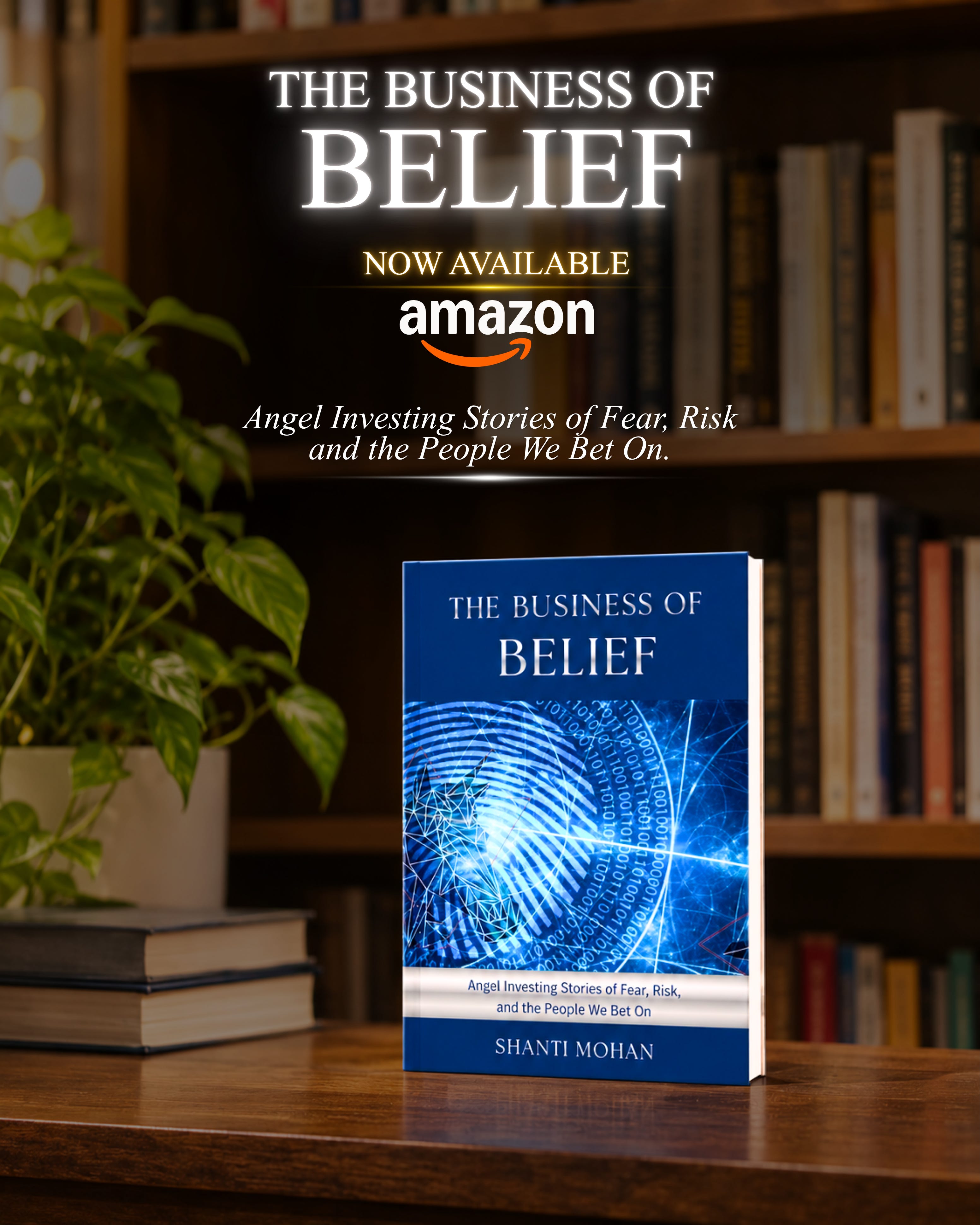
That is why the book is called The Business of Belief. Anything to do with money reflects our own biases and beliefs: the market we think will grow, the founder we think will beat the odds, or the feeling that the timing is right.
Writing it taught me that anything worth putting into the world has to be intentional. I am grateful to my friend and publisher Susan Jagannath, a bestselling author, for her patient guidance and hand-holding. The process felt like building a startup, and I will share more of what I learned in the coming weeks.
Why you should read it
You should read it because you are curious, and want to learn about money and the startup language. It is written from inside the Indian startup ecosystem, where I have spent twelve years writing cheques and made the mistakes. In the book I share the investments that taught me the most: the founder whose story I fell in love with, the market everyone called too small, and the ₹1.5 crore exit offer I turned down as an early investor, before the company went to zero.
You should also read it because the stories lead somewhere practical. They give you tools you can use at your next founder meeting or your next investor pitch: the 6C Framework, the Intent and Behaviour lenses, the Angel Investing Canvas, and a clear plan for when to hold and when to sell. Most investors, including experienced ones, have no plan for the sell decision until it is already upon them.
And you should read it because it will make you better at the conversations around money. Whether you are writing your first cheque or your fiftieth, it will make you a sharper judge of founders, and of yourself.
It will also help you talk about funding with a friend who is starting up, or with your child who tells you one day that they want to be an entrepreneur.
The book went live on Kindle yesterday. If this sounds useful, please download it today, because early downloads and reviews in the first week make a real difference to how many people get to see it.
Get it on Kindle: https://www.amazon.in/dp/B0HQBS6PNX/. Print edition coming soon.
Congratulations Shanti on your first book. Loved the theme and topic covered. Can't wait to read.