


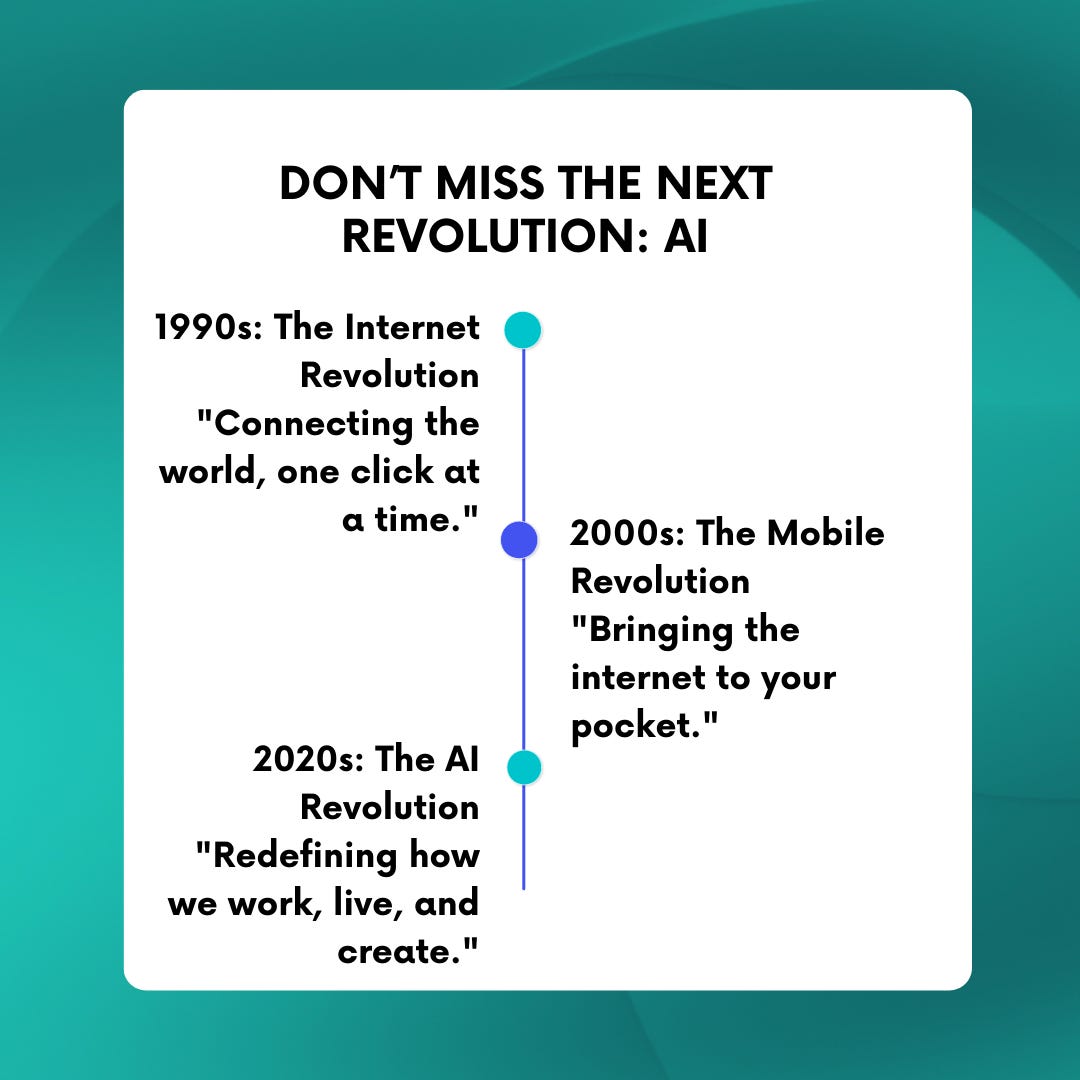
Looking back at 2024, AI has reshaped how we work. Let’s Unbox this generational shift. It’s fascinating, a bit daunting, and feels like a shift for generations to come. AI is a life defining shift, and as a founder and investor I have a front row seat to witnessing (and harnessing) this shift. AI feels like the early days of the internet and mobile revolution (for those who have been doing this long enough) - miss it and you will miss the next generational shift.
Conversations That Made Me Think (and created FOMO)
I felt compelled to write this post - as a record of what we are experiencing in all areas of our lives, love and startups. Certainly AI is here to change how we live - that is a surety. As a founder, I’ve always prided myself on staying grounded. Yet, I’ve felt the pull of FOMO more this year than ever before. AI has opened doors I hadn’t thought to walk through. From brainstorming ideas, to automating tasks I used to delegate, to evaluating and listening to founders building in the space, it has become both a partner and a challenge—pushing me to rethink how I operate as a founder and investor.
This year has been a whirlwind of learning sparked by thought-provoking conversations. From the Jensen dinner to the South Park Common meetup in Bangalore and finally the AI Leader Series I co-hosted, each event deepened my perspective. Conversations on AI have ignited thoughts, ideas and actions in the many founder groups, creator groups and the multiple AI communities. There are a multitude of opportunities that serve to fire up even more questions.
I am hungry for knowledge - when I meet someone, I want to know how they are using AI and their views. I realise how much is about to change in how we think, design and execute as founders. Yet, as much as AI unlocks incredible opportunities, it also comes with profound questions. Yuval Noah Harari, the author of Nexus, warns us about the pitfalls of AI—the ethical dilemmas, the societal divides, and the risks of losing human agency to machines. As I’ve experienced firsthand, this is not just a arcane conversation for futurists; it’s a reality that founders, creators, and enterprises are grappling with today. And must master, or fail.
The tools are here, the communities are forming, and the possibilities seem endless. But this isn’t just about leveraging AI—it’s about understanding its power, its risks, and its impact on the way we build and live in the future.
In an in-depth discussion with a VC about the challenges and opportunities that AI is bringing to the table, key point was how startups—and even enterprises—are navigating the balance between efficiency and human value. I shared how I’ve hesitated to hire a founder’s office or admin role, not because the tasks aren’t important, but because AI tools have filled so many of those gaps, and I am still unable to decide how to delegate.
Yet, this VC raised an interesting perspective:
AI might be automating processes, but it can’t yet replicate the intuition and judgment of a trusted human counterpart.
This struck a chord as I reflected on how AI has amplified productivity but also redefined the value of collaboration and delegation.
My 5 Key Takeaways
1. AI for Founders: Starting up will become “Easier and Harder”
My conversations with founders makes one thing clear: AI is revolutionizing how startups are built. A presentation from a first-time founding team who launched their business entirely with AI tools—no team, no outside help. They automated customer support, created personalized marketing campaigns, and even prototyped their product—all with AI. It was fascinating to see how much is possible now, even for someone with minimal technical skills.
What is Easier? (or is it Opportunity?)
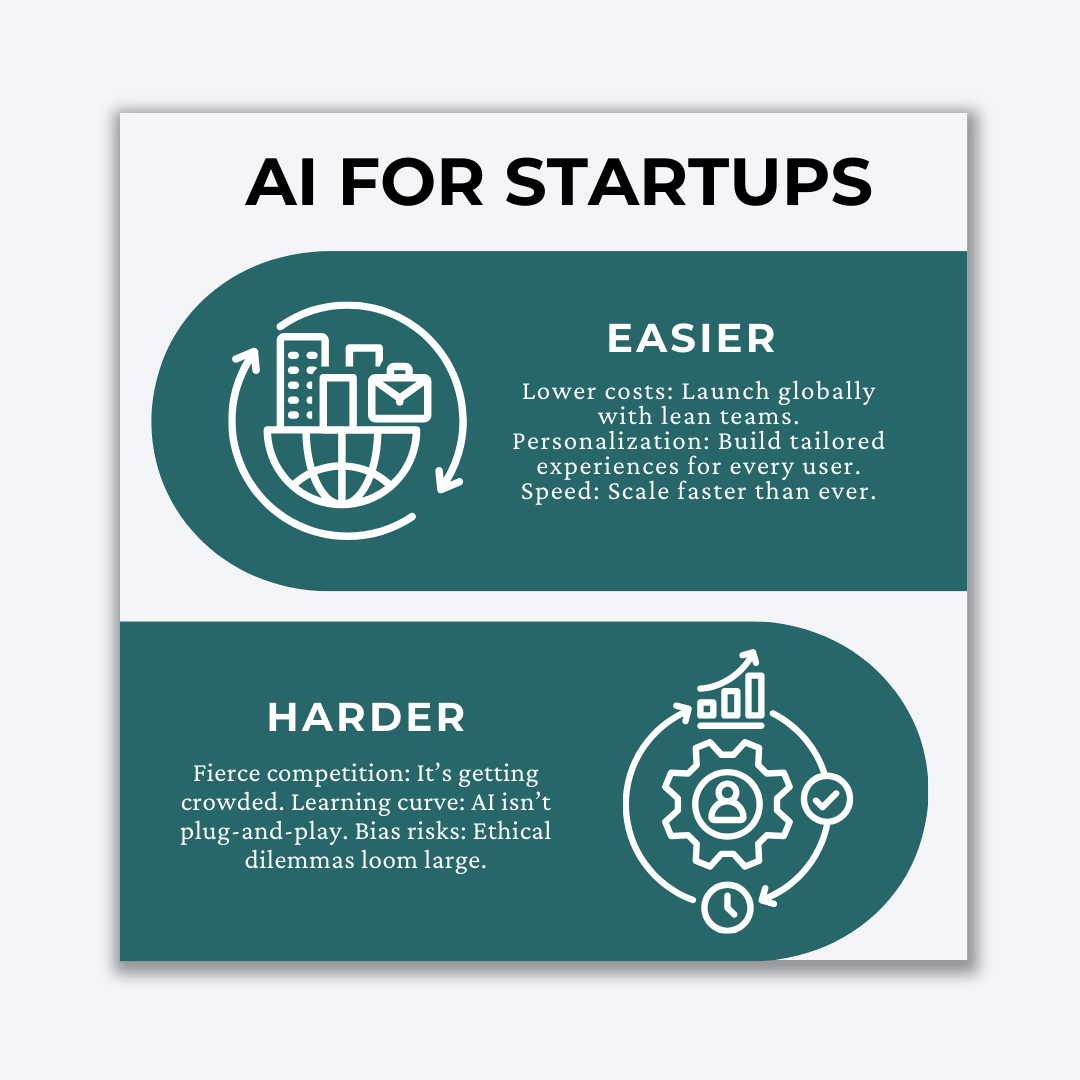
Lowered Cost of Entry: Over the past two decades, starting up has become easier. AI has taken this further, breaking down barriers entirely. From automating mundane tasks to generating insights, AI makes it possible to launch with far fewer resources.
That same founder told me, “I never thought I’d be able to scale this quickly without hiring a team. AI has been my secret weapon.”
Global Reach from Day One: AI has also made global markets more accessible. Startups can now automate multilingual customer interactions, reaching audiences they couldn’t have dreamed of before. Imagine building a product in English and having it connect seamlessly with users in Japan, Brazil, or Germany—all on day one.
Personalization at Scale: Perhaps the most exciting part? Personalization. AI enables founders to tailor experiences for customers at a level that used to require massive budgets. Think e-commerce stores that recommend exactly what a user needs or chatbots that feel like human assistants.
What is Harder? (Or is it Challenges?)
But like anything transformative, AI comes with its own set of complexities.
Fierce Competition: As AI lowers barriers, more people are jumping in. It’s exciting, but it’s also crowded. The challenge is standing out in a sea of new ideas.
I’ve seen it firsthand: startups relying too heavily on AI often struggle to differentiate themselves in crowded markets. The tools are accessible, but the vision and execution still needs to be sharp.
Steep Learning Curve: While AI is powerful, it is NOT plug-and-play. Founders need to invest time to understand the tools and use them effectively. I’ve had my fair share of frustrating moments trying to make an AI workflow work seamlessly—it’s not always as simple as it looks.
Bias and Ethics: The biggest challenge, in my view, is navigating AI responsibly. Using AI in hiring, lending, or other sensitive areas comes with serious risks if not handled carefully. Imagine an AI system unintentionally discriminating because it learned from biased data—that’s a reputational and ethical minefield no founder wants to navigate.
Prediction: While starting up becomes easier, as an investor, navigating the complexities of evaluating what is differentiated is going to be harder.
2: AI at the Enterprise Level: A New Playground being designed
At the enterprise level, insights from the frontlines reveal a complex story. From my conversations and observations this year, several major trends stand out:
Proprietary AI Solutions and Vertical AI:
Companies with access to proprietary data are leading the way in building tailored AI solutions, particularly in industries like healthcare, finance, and manufacturing. Vertical AI companies—startups focused on industry-specific solutions—are gaining traction, addressing challenges that generalized AI cannot.On-Prem AI Adoption:
Enterprises are increasingly cautious about AI implementation. Concerns over data security and compliance are pushing many businesses to seek on-premises AI solutions rather than relying solely on cloud-based systems.The Economics of AI: A New Business Model.
A key shift is AI’s impact on traditional subscription models. AI doesn’t scale in the same way SaaS does, primarily because of its high computing costs. This has given rise to new pricing models like "Outcome as a Service", where businesses charge customers based on measurable outcomes instead of recurring subscriptions.
Prediction: For startups, building for the enterprise, we will see changes in monetisation models, balancing the cost of computing with delivering tangible value to customers. Outcome-as-a-service will go mainstream (Will Software-as-a-service become service-as-a -software?)
3: AI and Robotics: The Physical World Meets AI Brain
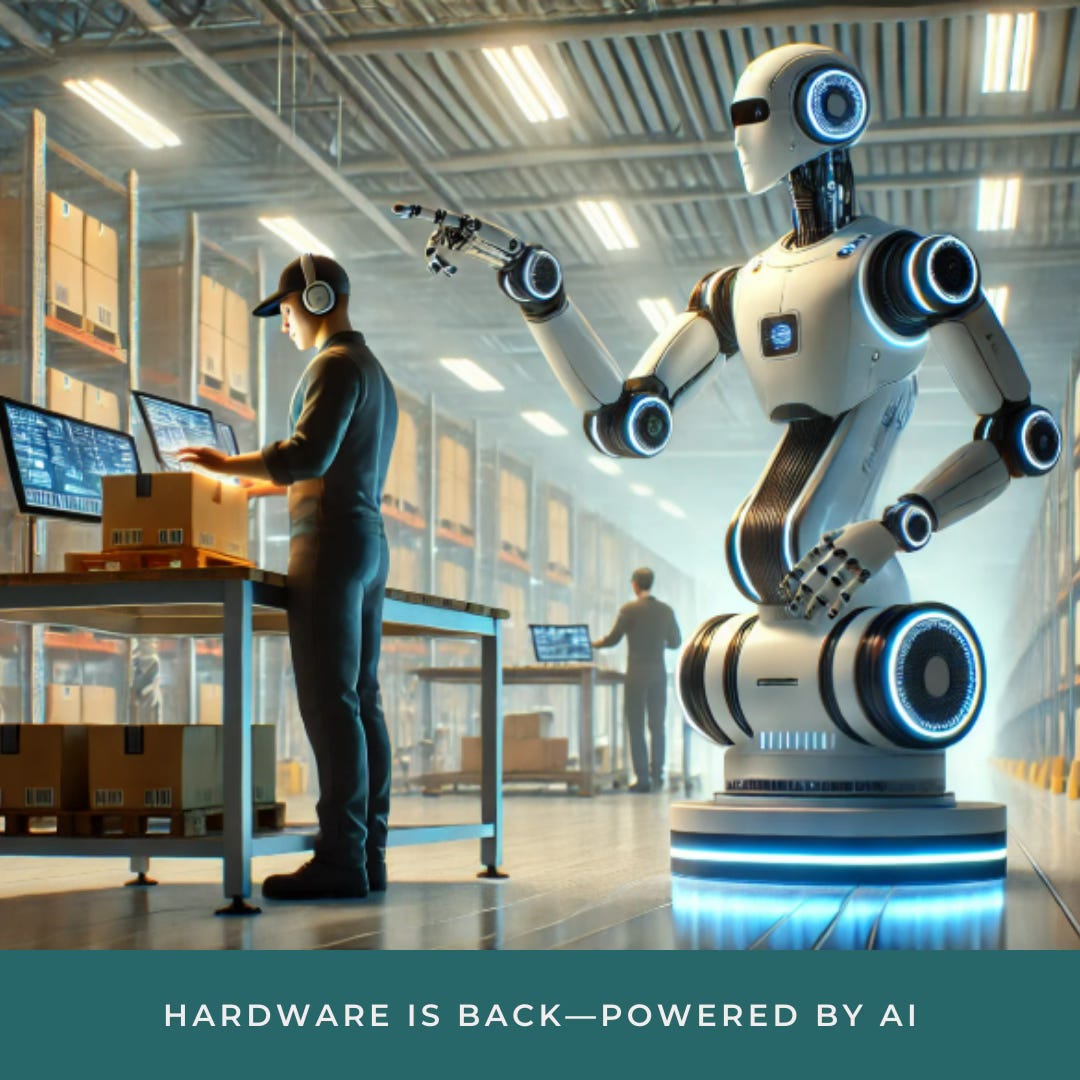
The integration of AI brains into robotics is redefining automation and human-machine interaction. While software-driven innovation has dominated the past decade, hardware solutions and IoT-based applications are now stepping back into the spotlight, driven by advancements in AI-powered robotics. This intersection is creating unprecedented opportunities for enterprises and startups alike.
Large Language Models (LLMs) Transforming Robotics
Large language models like OpenAI’s GPT and Google’s PaLM are not just revolutionizing text-based tasks—they’re being adapted to teach robots to understand and interact with the world.
Natural Language Processing (NLP) for Robotics: Robots equipped with LLMs can interpret human instructions more intuitively, enabling seamless collaboration between humans and machines. For instance, a robot in a warehouse can understand commands like, “Pick up the third item on the left shelf and place it in bin 5.”
Improved Learning Frameworks: By leveraging reinforcement learning, LLMs allow robots to “learn” from trial and error in simulated environments before deploying these learnings in the real world.
Resurgence of Hardware Solutions
After years of dominance by software-driven innovation, hardware is making a strong comeback, thanks to advancements in AI-driven robotics.
Collaborative Robots (Cobots) is now the new jargon: Cobots, designed to work alongside humans, are seeing widespread adoption in manufacturing, healthcare, and logistics.
Sensor Integration: Autonomous vehicles, surgical assistance, and precision farming will see new AI adoption.
IoT and Robotics Integration: The convergence of IoT (Internet of Things) and AI is giving rise to a new class of smart, connected robotics solutions. We have started to see more IoT based solutions in Agritech, and predictive maintenance in manufacturing.
The intersection of AI and robotics isn’t just advancing automation—it’s re-imagining how machines interact with the physical world. As hardware and IoT take center stage, enterprises and startups alike will need to harness these synergies to create impactful, scalable solutions
Prediction: Startups that focus on niche applications, like precision agriculture or healthcare assistance, are poised for growth. India, fueled by the Make in India initiative and its manufacturing push, will emerge as a hub for robotics innovation.
4: AI and The Creator Economy : Set to explode
The creator economy is poised for exponential growth as AI tools democratize content creation. Platforms like MidJourney and ChatGPT enable creators to produce professional-grade content without large teams or budgets.
The rise of micro-creators
From solopreneurs to niche influencers, AI is fueling the rise of micro-creators by lowering entry barriers and scaling creativity. The wave of micro-creators, crafting regional content, newsletters, and hyper-specific podcasts comes with fierce competition, making differentiation a greater challenge.
Key Differentiators: The heart of success will remain unchanged: connection, relatability, and trust. Storytelling, and community engagement will become key differentiators.
As audiences seek deeper connections, creators who can blend AI efficiency with a unique personal touch will thrive in this dynamic, expanding ecosystem. Creators like MrBeast demonstrate that while AI can amplify creativity, the heart of great content remains connection and relatability.
Prediction: Content will get commoditized. We will see the rise of creator communities, and more regional and hyper local content get consumed. Creators who master the balance between technological innovation and human authenticity will define the next wave of the creator economy.
5: AI and Access: The divide will deepen
AI has lowered barriers for many, enabling solo entrepreneurs to do the work of entire teams. Tools like ChatGPT, Gamma, and Notion AI has become essential in my own workflows. Yet, this democratization raises a critical question: Is AI inadvertently creating new divides?
Empowered Entrepreneurs:
Founders who can afford and understand these tools are launching businesses faster than ever. They can run operations leaner, innovate faster, and reach customers globally.The Left Behind:
Meanwhile, those without access to high-quality data, computing power, or the expertise to deploy AI effectively risk being sidelined. Some established enterprises are struggling to align their data strategies and adopt AI meaningfully.
Prediction: In 2025, AI will further accelerate the rise of empowered entrepreneurs, enabling solopreneurs and small teams to operate at enterprise-like scales with minimal resources. The democratization of AI will spark innovation in underserved markets, but systemic challenges like affordability, infrastructure, and skill gaps must be addressed to ensure equitable growth. Collaboration will be key.

Summary: Key Takeaways and Predictions
Key Takeaways from 2024:
AI Reshaping Startups: Starting up has never been easier, but fierce competition and ethical complexities make differentiation critical.
AI at the Enterprise Level: Enterprises are embracing proprietary AI solutions, on-prem AI adoption, and outcome-based pricing models.
AI and Robotics: The convergence of AI, IoT, and robotics is redefining automation and interaction, with India emerging as a key innovation hub.
Creator Economy Surge: AI is empowering creators, leading to hyper-localized and commoditized content. Authenticity will remain the differentiator.
Deepening Divide: While AI democratizes tools for many, access gaps and affordability challenges may deepen divides, necessitating collaboration for equitable growth.
Predictions for 2025:
Startups: Starting up will become both easier and harder as AI levels the playing field but increases competition.
Enterprises: Outcome-as-a-Service models will mainstream, reshaping monetization strategies.
Robotics: India will lead robotics innovation, particularly in niche areas like agritech and healthcare.
Creators: Creator communities and hyper-localized content will thrive, but connection and trust will define long-term success.
Access: Empowered entrepreneurs will rise, but addressing systemic challenges like infrastructure and affordability will be vital for inclusive growth.

As we stand on the cusp of this generational shift, one thing is certain: AI is not just reshaping how we work, but how we define opportunity, connection, and impact. The question now isn’t just what AI can do, but how we, as founders, creators, and leaders, will choose to shape the future it enables.
Have a good December! Get ready for a 2025 that none of us can predict.
Team LetsUnBox
Excellent One !!