


Through our PitchRoom season, we have discussed how startups are curated, how decisions are made, and how we should think as angel investors.
The last two months have been busy — the good kind of busy. I was part of Bharat Ke Super Founders (BKSF). With every episode launch, I received messages from friends asking the same question: Why did you invest? How did you decide on the amount and what does the amount and valuation mean?
That is when I realised we now have an unfair advantage.
Earlier, when I wrote for The PitchRoom, I often used Shark Tank examples to explain investment thinking. I was speculating with the limited information I had from the outside. They were useful — but incomplete. What we see publicly is edited storytelling.
During BKSF, I saw the full founder conversation — problem depth, numbers, behaviour under pressure, and conviction. That changes how you evaluate a startup.
This series will use my Angel Canvas to explain exactly why I invested — and why I passed — based on what actually happened inside the pitch room.
Let us start with Digital Labour Chowk.
The Pitch — What I Saw Inside the Room
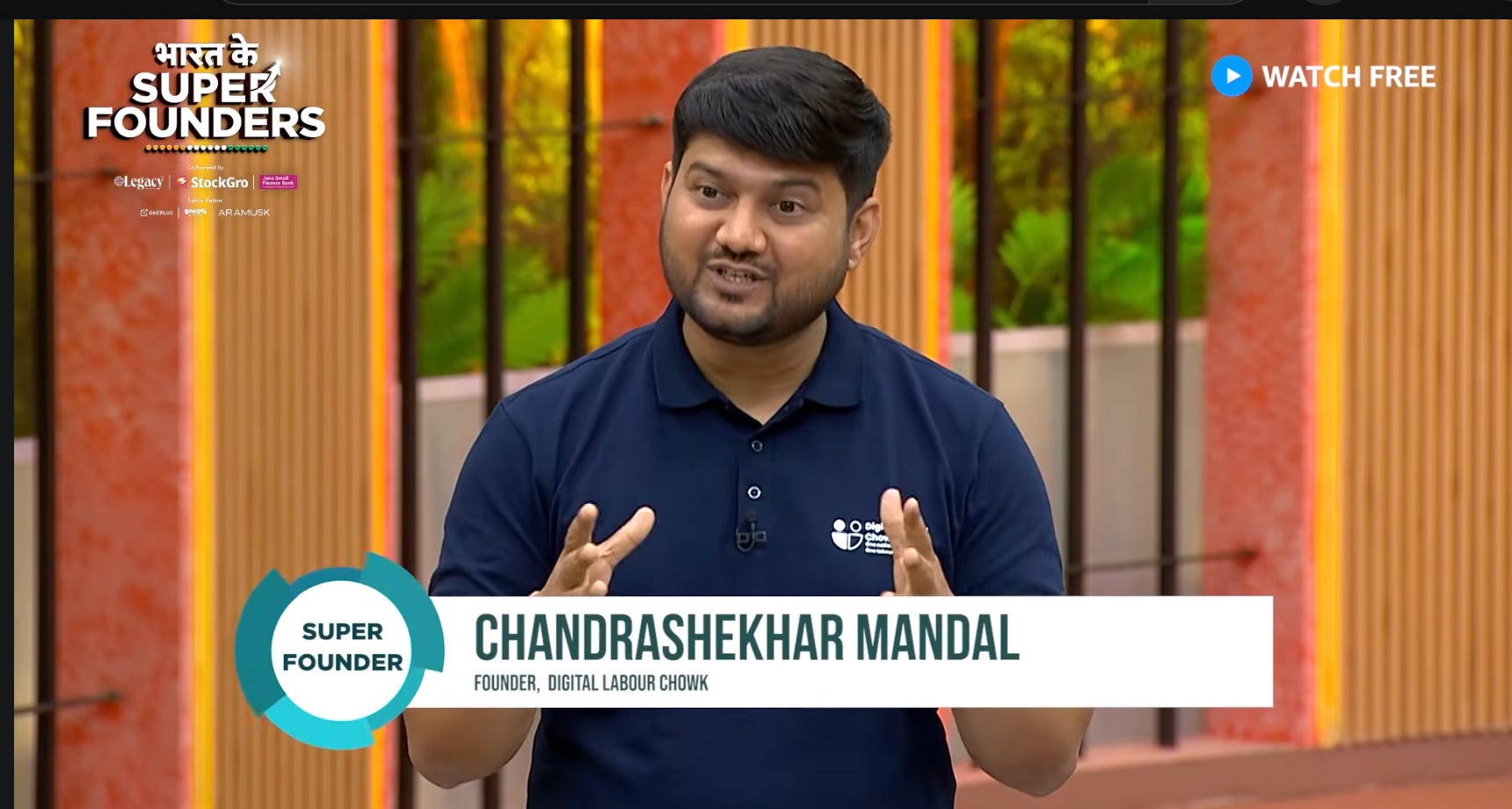
I had known Chandrashekhar for almost two years. I first met him at a conference when the company was still discovering its core value proposition and understanding what customers truly valued.
The founder who presented during BKSF was different from the early version I had met. He was clear, grounded, and confident — not performative confidence, but the kind that comes from time of building from the inside, deep engagement with customers and a real understanding of the problem.
What I also liked is he represents a true Indian founder - someone who speaks Hindi (beyond the validation we seek in English) and presents his view with confidence. It is easy to watch as investors, but not easy when you are the founder presenting to a room with lights, cameras and investors seated in front. If you watched the pitch - Chandra presented the demo of his product and the growth numbers. The conversation also focused more on behaviour — how daily-wage workers actually find jobs, how contractors make hiring decisions, and where trust breaks down.
The Problem From The Ground
Construction is India’s second-largest employer. Yet most labour operates in an informal, cash-based ecosystem.
Workers struggle with:
inconsistent income
no verifiable work history
no certification
lack of insurance or access to formal credit
Contractors struggle with:
discovering reliable labour
verifying skill levels
managing project uncertainty
Assignments are project-based, with unclear timelines and locations. Both sides operate with incomplete information. Decisions are inefficient because there is no structured discovery layer.
The Structural Opportunity
Digital Labour Chowk is building infrastructure around:
worker identity and certification
job discovery
trust between workers and contractors
skill tracking
access to financial services
In future, a certification layer could help governments deliver benefits accurately and help contractors identify skilled labour more reliably.
The platform could also enable insurance, health checkups, and credit — benefits largely absent in today’s cash-driven system.
There is also a skilling opportunity. The construction ecosystem still operates through informal apprenticeship models — the ustad–shagird structure. A digital platform can formalise and scale this learning pathway.
The Data Shared During The Pitch
What cameras do not show
Inside the room, the most important signals were:
clarity when questioned on monetisation
honesty about operational challenges
deep familiarity with worker behaviour
comfort discussing failures and pivots
These are signals rarely visible in edited formats. Also what we witnessed was a deep connect to the problem, with some of the tycoons having lived this, and struggled with no access. I think in our busy lives we forget the class of people who are ‘invisible’ to us, and who don’t have systems to enforce equality and labour dignity. This is the India we live in today, even in the 21st century with all the advancements in technology.
Why I Invested


Digital Labour Chowk is Building India’s Labour Backbone 🇮🇳.
Thesis: India wants to be a $55T economy by 2047. But growth depends on the people who build our cities. Construction is India’s second-largest employer.
Yet labour remains informal, invisible, and unverified.
The Problem:
In today’s system, we have the following challenges:
• No verified work history
• No structured discovery
• Cash-based “deehadee” economy
• No benefits
• Contractors struggle to find skilled labour
• Workers struggle to find consistent work
This results in inefficiency on both sides.
My 5 lens mapped: (refer to this post if you want a refresher)
Lens 1: Founder Clarity
This is lived experience. The founder has worked closely with daily-wage workers. The team reflects ground reality — not consulting assumptions. This is not a deck problem.
It is a lived problem.
Lens 2: Category : Fit (India Stack + OCEN)
This is a reflection of market size. India has built digital infrastructure for identity and payments; We see the impact of Aadhar, UPI and the digital infrastructure. Now with new protocols like OCEN, we will see livelihoods as the next layer.India built identity and payments:
DLC adds the missing layer: Identity + Work + Wages + Trust
Lens 3: Capability (Traction)
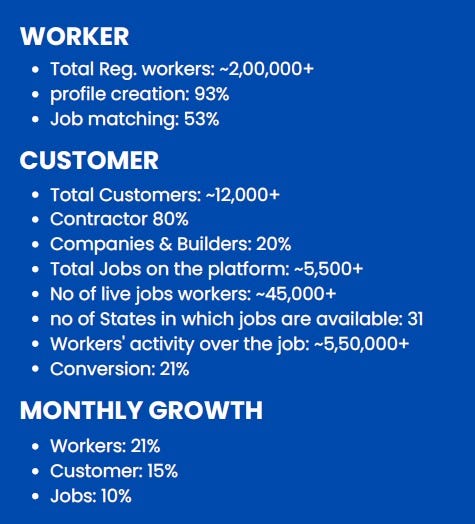
The platform is beyond proof of concept and there is strong early adoption and engagement. It has 2 lakh+ workers with 93% full profiles, 53% job match rate. They have 12,000+ customers with 5,500+ live jobs and presence across 31 states. This is a reflection of the team’s ability to execute and DLC is clearly beyond POC into product market fit.
This is early product–market fit.
Lens 4: Cost to Build = Trust
I have built LetsVenture and understand marketplaces deeply It is one of the toughest spaces to build in, but once built, very difficult to copy. At the core, marketplaces are build on trust. DLC shows trust through 5.5 lakh+ worker activities with 21% job conversion rate. This means fundamentals are working.
Capital now scales growth.
Lens 5: Scalability + Personal Lens
Jobs are universal. Each new worker strengthens the network.
There was also a personal layer. Growing up around industrial India of Jamshedpur shaped my understanding of labour dignity and economic mobility. While growing up in small towns has the best advantages in terms of the quality of life, it also comes with the challenge of lack of exposure for anyone wanting to be an entrepreneur. That perspective influences how I evaluate such opportunities.
This investment is both economic and deeply personal. I love it when businesses can create impact AND deliver value.
Impact and outcomes can coexist.
Structural Opportunity and TAM
What was missing in the pitch and what was unsaid is the huge structural opportunity that DLC unlocks. There is an opportunity to organise this space and offer worker certification, access to insurance + loans, verified skill tracking, enable government aid targeting, improve contractor quality on jobs.
This is infrastructure for livelihoods.
Why Now?
With the booming growth we are seeing in India’s construction, the country needs skilled labour, verified credentials, transparent discovery and workforce mobility.
Without labour infrastructure, growth slows.
What To Watch Going Forward
While I committed, we need to continue to watch for contractor retention, repeat hiring behaviour, certification adoption, financial services integration and regional expansion efficiency. Thats why building companies is always work-in-progress.
Closing Reflection
This is the first note in my Inside the Pitch series — where I write from the actual founder room, not from edited television narratives.
Angel investing is not about dramatic moments. It is about pattern recognition, behaviour observation, and structured thinking.
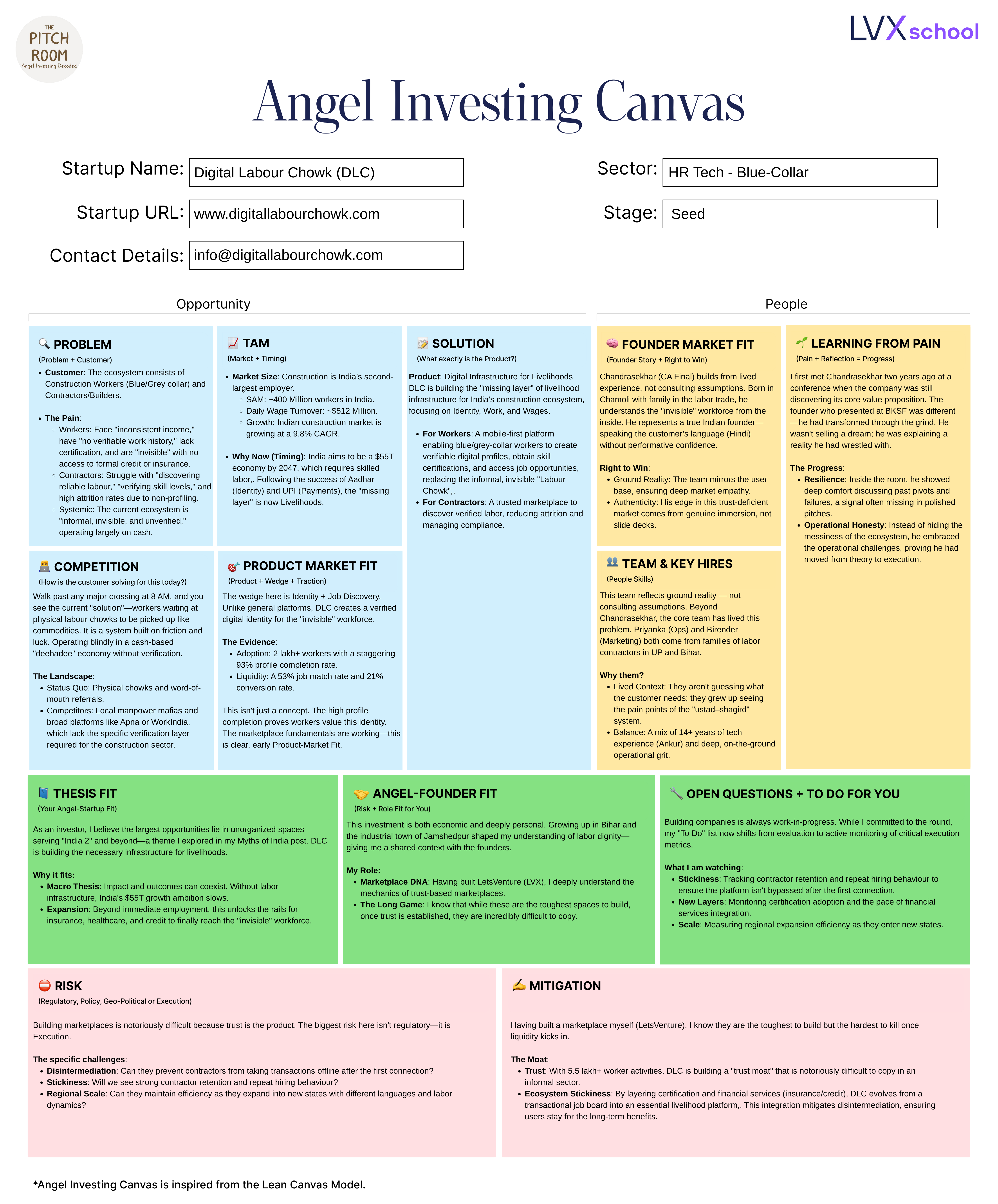
The Angel Canvas is how I bring clarity to those decisions. Sharing the summary here. Hopefully the learnings will help us all refine our skills and help us understand risk and investing better.
PS: This should not be considered as investment advice. This should purely be seen as a learning process. Your decision to invest should be made independently, based on your own thesis and analysis.
Signing off. Have a great weekend!
Regards,
Shanti
Watching the show and then reading this Behind The Scene (BTS) makes the whole process feel so much more realistic!
Clean analysis. A quick thought: Are shark tanks just about hype since 99% of the business talk happens behind the scene? - nevertheless it was a good pitch :)