

2025 has been an interesting year. We launched SamVed, a fund focused on Bharat opportunities. As I met founders building in the space, it was clear - a two market definition of India and Bharat was over generalisation of a much fragmented economy. It worked a decade back — income, access and digital adoption felt like clear dividing lines.
But as India’s digital economy matures, one truth is becoming harder to ignore — the old two-market narrative no longer explains how India behaves. Refer to this blog for reference (written almost 10 years back)
What looked like income variation on the surface was actually something deeper: differences in motivation, confidence, risk appetite, and willingness to pay.
The last definition of India 1 and India 2 started to feel insufficient.
Investors assume:
India behaves like one market
A behaviour in metros is repeatable nationwide
Price elasticity is similar everywhere
Consumers shift uniformly with income
This is why simply calling India “middle class” or “Bharat” hides more than it reveals. A granular view is essential to understand who actually spends, upgrades, experiments, or avoids risk.
This post is really focused towards founders who want more granularity in defining market size, and investors who want to evaluate for such solutions.
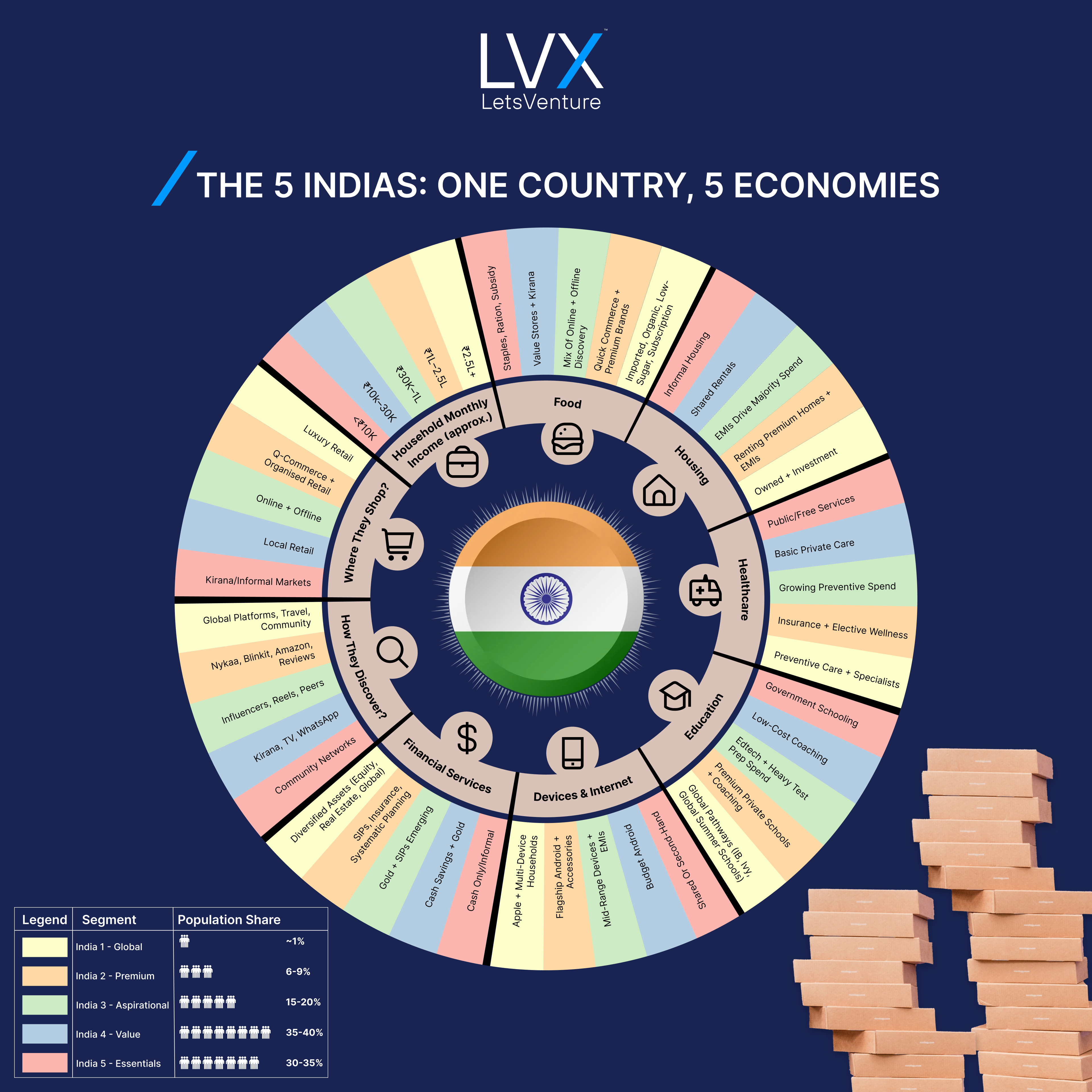
The New Lens: Five Indias
India is not one economy.
India is a mosaic — five India’s coexisting.
People across these India’s may use the same apps, the same payment rails, and the same internet, yet their motivations, spending logic, risk appetite, and willingness to pay are profoundly different.
To understand India today — and especially the next decade of startups — we need to understand:
who buys
why they buy
how they adopt
and how infrastructure shapes what they consider possible
Why This Segmentation Matters Now
The last decade of Indian startups was powered by access:
Jio brought the internet. UPI built trust in digital money.
Three enablers shaped the first wave:
Smartphones
Affordable data
Instant payments
The next decade will be shaped by:
Formalisation
Affordability + value creation
Aspirational identity formation
Digital Public Infrastructure (DPI)
Scaling in India will depend on which layer of India you build for - and how you cross over between layers.
The Five Indias Framework
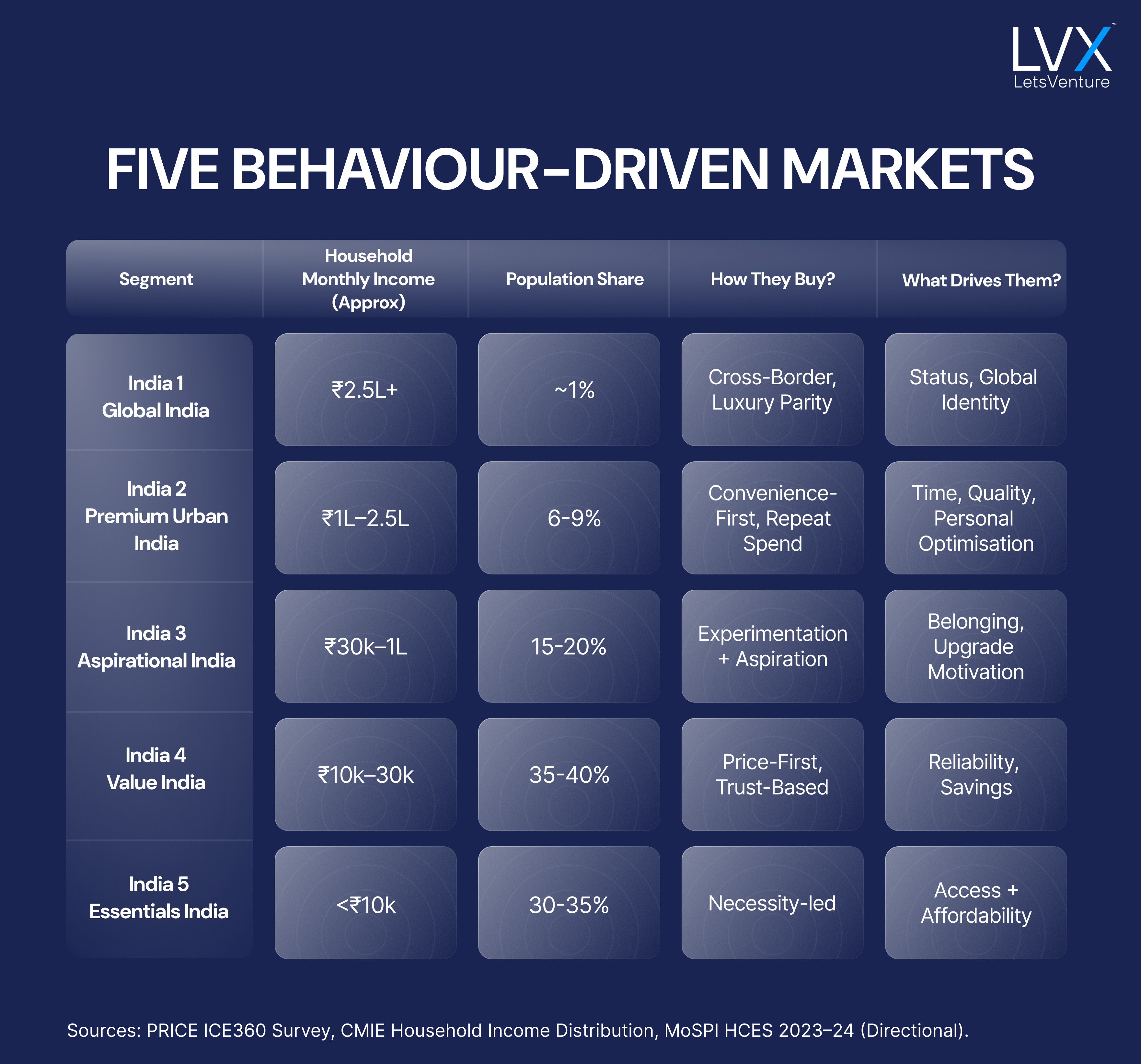
This framework was built with data using HCES 2023–24, PRICE ICE360, CMIE income distribution data and platform behaviour signals. I also referred to the latest public reports from Swiggy, Zomato and Nykaa to track some of the consumer behaviour. This emerged as a result — five distinct behaviour-driven markets.
The 5 India segments have been created based on income levels, but income does not explain the consumption story.
How India Works and Consumes
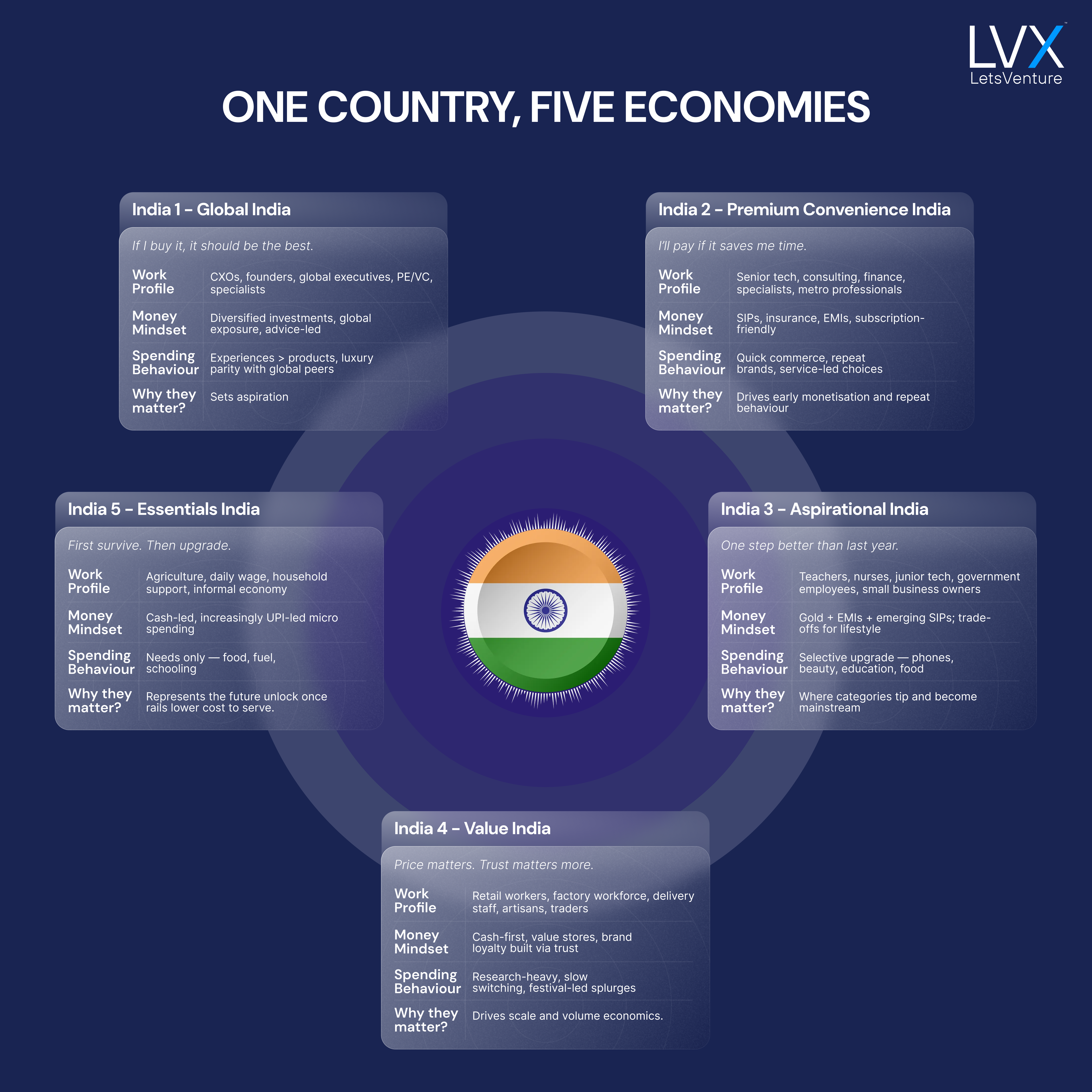
Income segments in India are deeply tied to how households earn, the stability of that income, and how that translates into spending behaviour. Consumption is not just a function of earning power — it is shaped by identity, confidence, risk appetite, and exposure.
The same household can show “value logic” in essentials and “aspirational logic” in lifestyle categories. This variability is not an anomaly — it is a defining feature of how India spends.
What Connects These Five Indias: Digital Public Infrastructure (DPI)
Even though they behave differently, these Indias now operate on shared rails:
Aadhaar
UPI
DigiLocker
Account Aggregator
ONDC
ONEST (logistics interoperability)
As the EkStep Foundation described it:
“India Stack helped people transact. ONEST will help businesses operate.”
This matters because rails collapse onboarding friction.
Infrastructure creates markets before brands do. Few countries have built rails before markets — and fewer have built rails that reduce operational friction for both citizens and businesses.
India is now shifting from digital payments infrastructure to digital operating infrastructure.
Where This Goes Next
Three forces will accelerate upward movement:
Lower friction (DPI)
Cheaper last-mile logistics
Better access to structured credit
But one force slows complete convergence:
Disproportionate income growth
So India isn’t merging into one segment — it is splitting further, but scaling faster.
Conclusion: What Founders Must Ask
India is not one market — it is five parallel economies shaped by income, identity, trust, digital rails and aspiration.
For me, this shift isn’t just academic — it has shaped how we now look at founders, products, and markets. At SamVed, we don’t look at “India” as one uniform demand curve anymore. We look at emerging behaviours across these five Indias — where aspiration is forming, where affordability meets access, and where infrastructure unlocks new categories.
Because the opportunity ahead isn’t in building for a billion consumers.
It’s in understanding which India moves first — and which India follows.
If you are a founder building in India, the real question now is:
Which India are you building for - and which India unlocks your next stage of scale?
This report has been summarised to simplify the messaging to readers. If you are a founder building for one of the Indias and want a more detailed analysis, drop me a comment with what you are looking for. I am happy to share notes.
Wishing all my friends a great start to the new year! We should all collectively pray for a safer, happier and more abundant world for us in 2026.
Signing off with much love for 2026