


Every early-stage investor is solving the same puzzle:
Is this startup worth my money — and how do I know?
In today’s world, every pitch is public — but the outcome stays private.
That’s why the gap between story and signal matters more than ever.
In this post, we go deeper into two contrasting startups from Shark Tank India Season 1 — one that’s scaling, and one that quietly shut down — to understand what signals investors could have spotted early:
What signs were visible in the pitch?
What could we have picked up as investors?
And how do we sharpen our ability to evaluate — one pitch at a time?
It is easy to get excited about charisma, storytelling, or traction slides. But the real work lies in building a consistent lens — one that helps you cut through the narrative and evaluate the business. In this post, we will introduce a simple, practical investor framework — and apply it to two contrasting startups from Shark Tank India Season 1
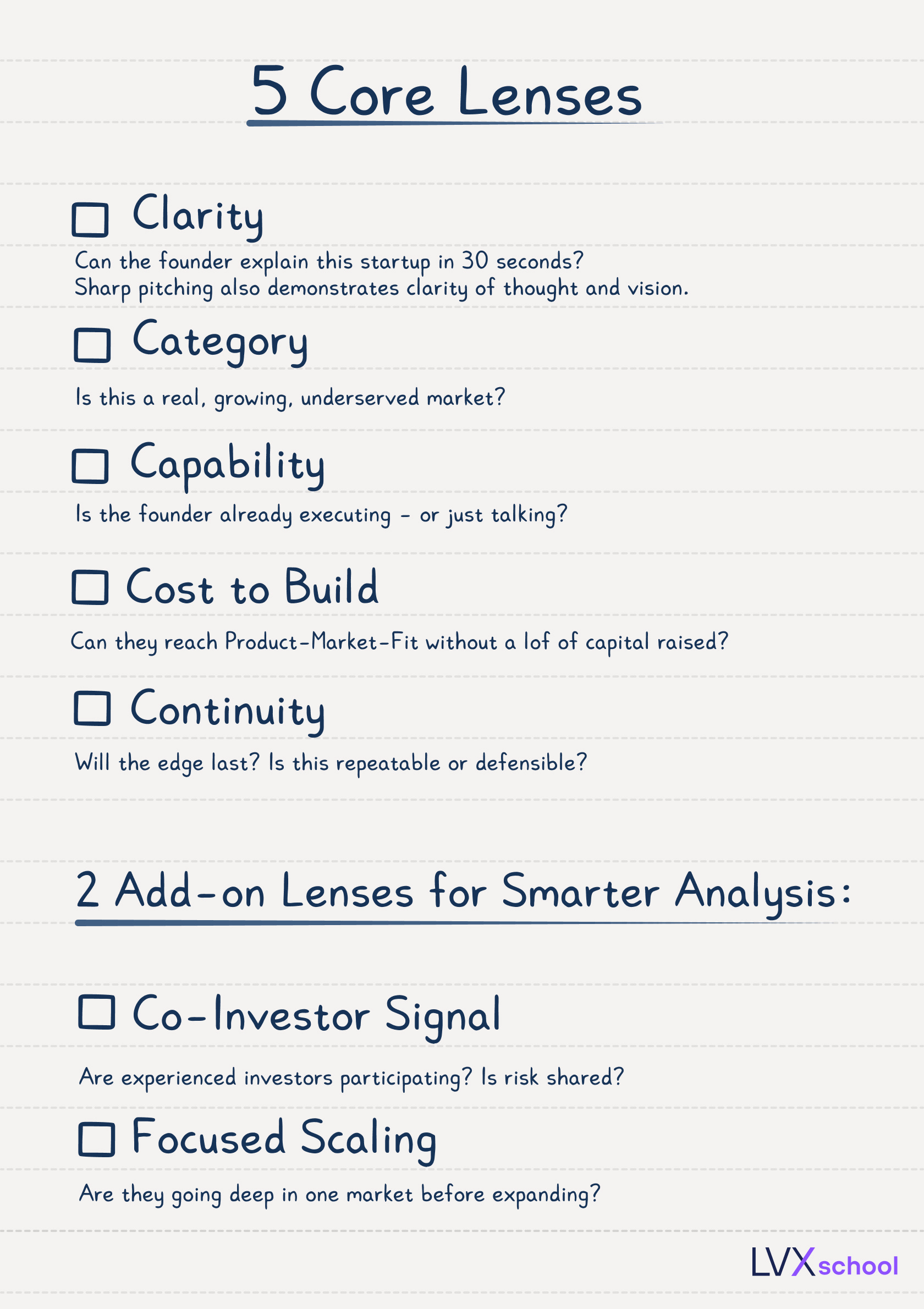
The PitchRoom Framework: The 5+2 Signal Lenses
Here’s your first practical investor filter. Use this every time you evaluate a pitch:
Case 1: Skippi Ice Pops – Funded and Growing
Deal: ₹1 crore for 15% equity
Sharks: All 5 (joint investment)
HQ at pitch time: Hyderabad
Status today: Active, expanding across India & into exports, Raised a round of 12 cr, with the goal of getting to 100cr revenues in 2025

Watch the pitch here.
What the pitch showed
Skippi didn’t just pitch a product — they pitched clarity.
First-mover in organising an un-organised market: organized popsicles.
Strong nostalgic + visual connect, creating emotional connect (key to their success)
Easy-to-execute branding
Already manufacturing and selling
Focused operations in a single city
But what truly stood out?
All 5 Sharks invested — a rare co-investment signal.
Co-investor confidence doesn’t guarantee success, but it signals strong potential and alignment across investor lenses.
(Example: Tanishq was successful as it organised the jewellry market, which continues to be fragmented with large regional players)
Scale Isn’t Wide. It’s Deep.
Here’s what most founders — and many investors — get wrong:
Scale isn’t about how many cities you’re in.
It’s about how well you’ve executed in just one.
Scale is defined as the ability to capture the smallest unit of a business, which can then be replicated across regions. Scale, as many people think, is not going wide.
Skippi was live only in Hyderabad. That wasn’t a red flag — it was a strength.
They were:
Streamlining supply chain
Learning customer behaviour
Getting ops right in one controlled environment
This shows strategic depth, not a lack of ambition.
As investors, this is a key filter:
Is the founder trying to win a market — or just spread thin?
Case 2: Booz Scooters – Funded, but unable to scale
Deal: ₹40 lakh for 15% equity from one shark
Model: Electric scooter rentals in closed campuses
Status: Last reported numbers are about 54L in annual revenue, with OEM partnership with EMotorad announced last year.

Watch the pitch here
What the pitch showed
Narrow Market, High Complexity: The business operates only in private premises — colleges, business parks, resorts. That instantly caps its market size. Each site requires individual permissions, docking setups, and maintenance — high friction for growth.
Investors often confuse “niche” with “moat.”
Booz’s niche wasn’t defensible; it was small.Weak Unit Economics: Fleet‑based businesses look appealing until utilisation drops. Scooters that don’t move, don’t make money.
Maintenance, charging, and staff costs add up fast — and in closed campuses, usage peaks only at certain hours.Capital-Heavy and Hard to Scale
The Illusion of Early Traction: Early traction with lack of repeatablity is tough to scale.
Despite early traction, Booz struggled with operational economics — a reminder that product finding a narrow application won’t scale easily.
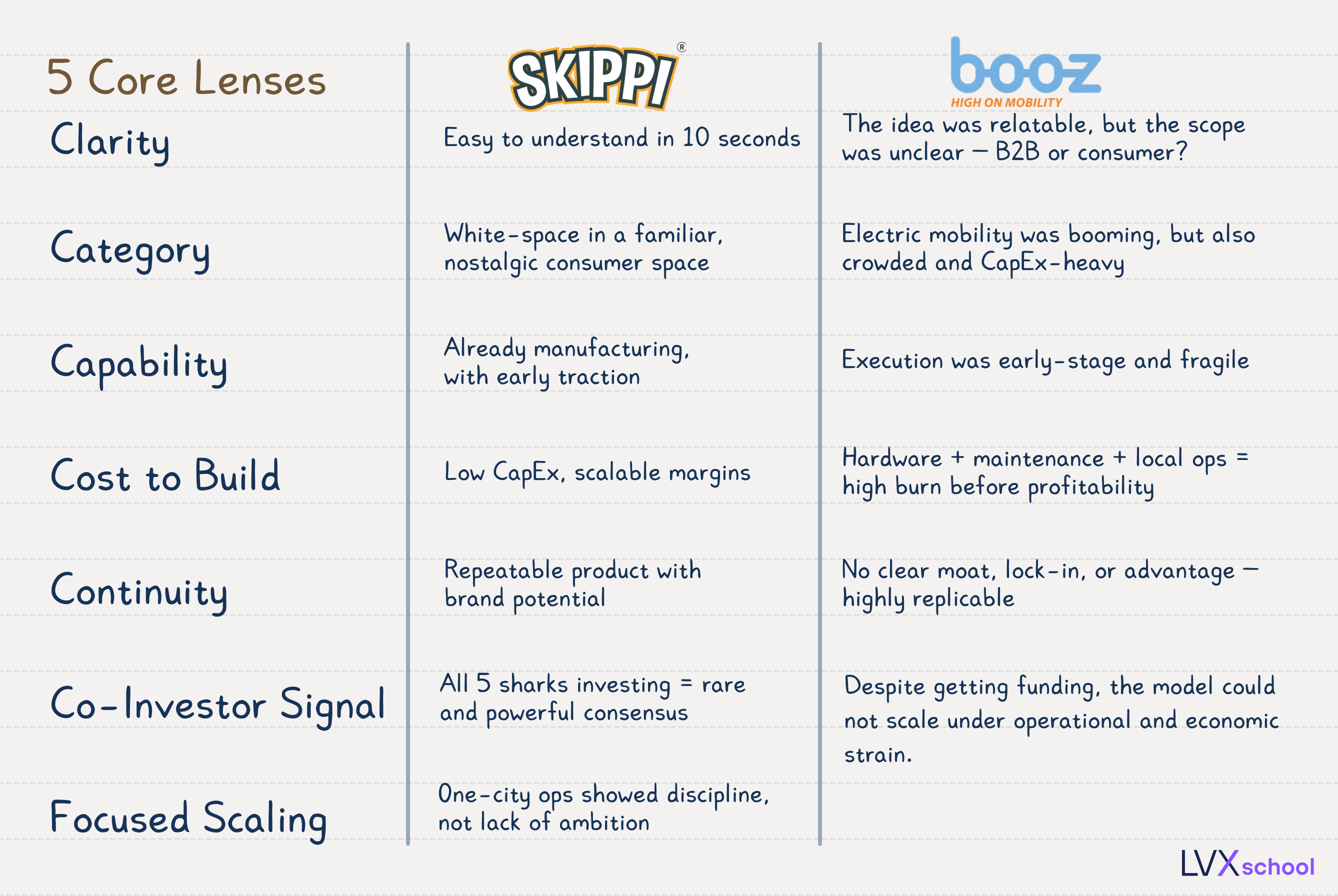
Applying the Framework
Jargon Buster - Understanding TAM: What Was the Real Market?
Skippi claimed to tap into a ₹3,000 crore frozen food market. Sounds big — but the real question isn’t “how big is the pie?” It is: “how much of this pie can they actually eat?”
Most founders quote big top-down numbers. Good investors build bottom-up intuition.
Investor Tip: Build Your Own TAM Estimate
When a founder says:
“This is a ₹5,000 crore market…”
Don’t stop there.
Ask:
What part of that is actually addressable — now?
Here are 3 practical ways to start: ( we will dig deeper on the exact methodoly in a later post)
1. Bottom-Up TAM
Estimate customers × annual spend
2. Top-Down Sanity Check
Use Google, ChatGPT, or industry reports to validate assumptions
3. Comparables Method
Find similar startups and extrapolate based on their revenue share
You don’t need perfect numbers — just curiosity and critical thinking.
Want to go deeper? Read this detailed note:
Understanding TAM Beyond the Pitch
Reflection Prompt
The next time you watch a pitch — on Shark Tank, at a demo day, or in your inbox — try this:
Apply the 5+2 Lenses
Note which signals felt strong or weak
Try estimating TAM on your own
Ask yourself: Would I still invest if the pitch was 50% less exciting?
Look at parallels in public markets (we will cover this in one of the posts)
Look at sectors that have tailwinds where a small market could potentially become big.
This is the real work of early-stage investing.
Join The PitchRoom WhatsApp
A private learning space for founders, investors, and the startup curious.
No spam. Just real-world analysis, prompts, and frameworks.
Coming up next:
2000cr too small for TAM? We will breakup the TAM for Skippi, and analyse if the numbers reflect the guideline for angel investing.
This is an excellent breakdown of what separates successful startups from those that struggle! The PitchRoom Framework really crystallizes the key difference: Skippi mastered depth before attempting breadth, while Booz faced the classic trap of high operational complexity in a narrow market.
I particularly appreciate how you highlighted that "scale isn't wide, it's deep" - this is such a counterintuitive but critical insight for early-stage investors and founders alike. The side-by-side comparison makes the signals incredibly tangible and actionable.
Regarding the investor framework, your dissection of signals is brilliant, though I wonder if more qualitative, human-centric data points are crucil for true long-term impact.