


When we talk about venture, the conversation almost always ends up being about people.
Venture investing is about finding the smartest people building the smartest solutions — solving problems worth solving, or creating possibilities that make life better. If you look back in history, most inventions happened because someone believed there was a better, more efficient way to live.
The internet, the mobile phone, social media — all had this belief at their core: there must be a better, more connected, more meaningful way to live. That’s what we like to believe.
In venture, we sit at the edge of that transformation. And transformation happens when the human mind can visualize, comprehend, and create something valuable for our daily lives. That is real disruption.
On Cycles and the New World Order
I’ve been following some of the leaders in the financial world — Ray Dalio and Morgan Housel who have deeply shaped how I think about money. Both study history to understand how markets and human behavior move in cycles — how every upcycle inevitably follows a downcycle.
If I draw a parallel, I believe India is entering an upcycle — one that will sharpen over the next decade.
As investors, the question then becomes: can we predict where this new world order will move? More importantly, can we identify the people who will be its architects?
Why People Matter Most
This post, unlike others, is more philosophical. Because no conversation on investing is complete without a conversation on people.
From managing large teams to building LetsVenture, to meeting founders and investors across India and globally, one thing always stands out for me:
Find the right team with the right intent — and magic will happen.
But how do we identify them?
Lessons from the Mountains
A few months ago, I attended a writing workshop in the mountains — mostly to support a friend. I didn’t expect it to change how I think about people.
Listening to fellow writers share their stories, I realized something profound:
Our childhood experiences shape everything — how we trust, love, lead, and define success. These stories become the lenses through which we see the world — and inevitably, how we build companies.
As people, we often glorify struggle. But adversity, at its core, is just a story — one that reveals what a person chooses to hold on to and what they can let go of. Some narrate their struggles in vivid detail, reliving the unfairness of it all. Others process, reflect, and move forward with empathy.
The difference lies in what they learn from pain.
Ray Dalio said it best:
“Progress = Pain + Reflection.”
Becoming aware of pain is one thing. Staying a victim to it is another. The real growth happens when pain leads to reflection — and reflection building into empathy.
The real question for investors is:
Can you identify founders who live by the Progress mindset? As investors, unless we build awareness and the ability to deeply listen, we’ll miss the mindset behind the people we invest in.
Building a Framework for People
As investors, we can build frameworks to understand people — their values, behaviors, and how they respond to change.
The truth is, during fundraising, founders are at their best behavior. Once the money is wired, the real leadership begins. People change — and that’s not always bad. Growth demands change.
But investing in early-stage founders is like picking a chess prodigy in a room full of hopefuls. Everyone wants to be a grandmaster. Only a few stay long enough to become one.
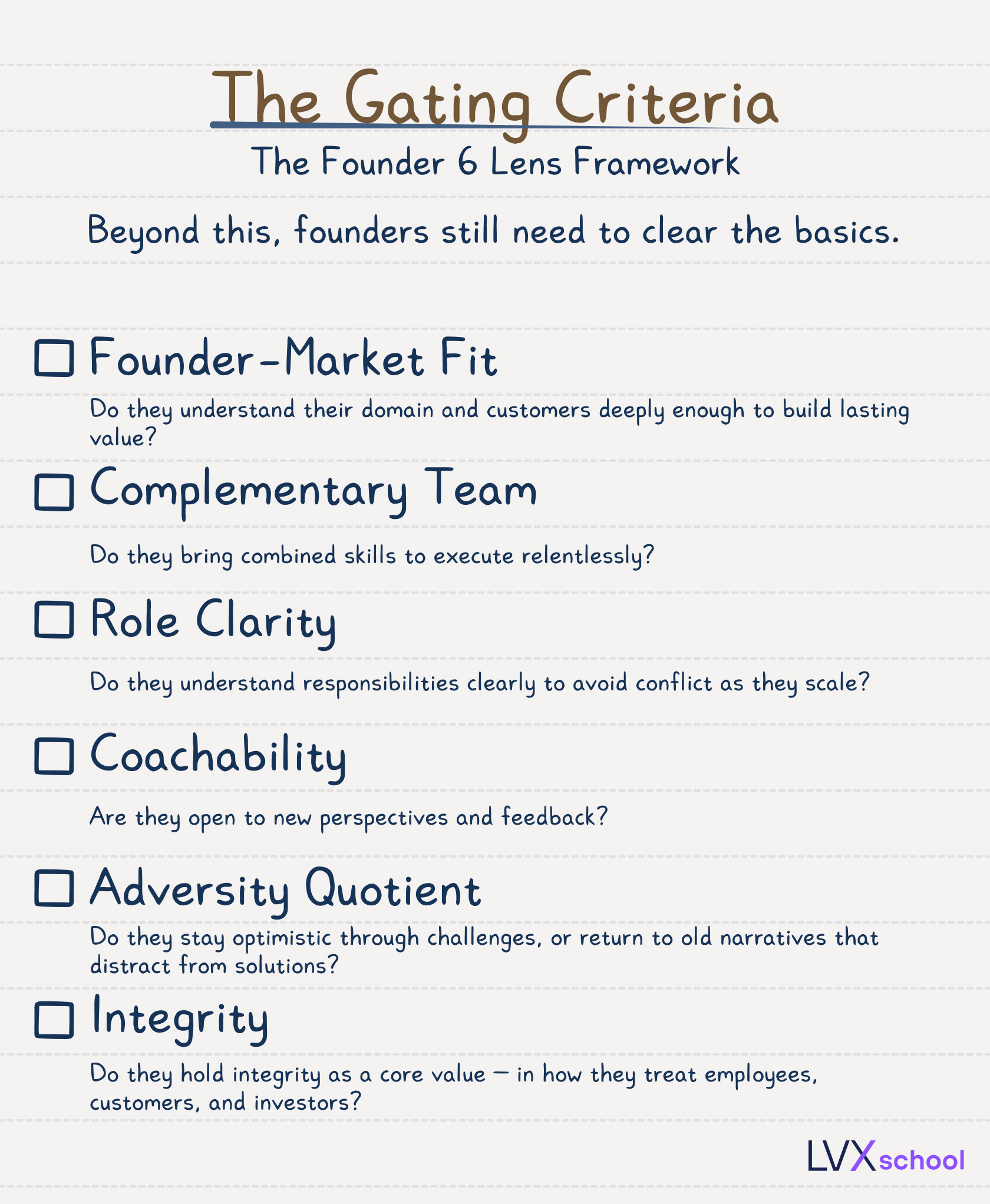
And yet, some founders who tick every box fail.
That’s why venture investing — at its heart — remains the most human form of capital. We’re not just betting on markets or technology. We’re betting on people — and their ability to learn, adapt, and grow. And to demonstrate the “progress mindset”
Join The PitchRoom WhatsApp
A private learning space for founders, investors, and the startup curious.
No spam. Just real-world analysis, prompts, and frameworks.
Coming up next:
In the next post in The Pitch Room series, I’ll explore this question further:
Can we build a repeatable framework to evaluate founders beyond the pitch?
A lens that captures not just what they build, but who they are.
Interestingly, this also sheds light on why alma mater (external network) carries such weight in the ecosystem. Founders from IITs, IIMs, ISBs often have certain structural advantages—not just in terms of credibility, but in the networks and institutional frameworks they've internalized.
Similarly, backgrounds from top corporates (McKinsey, Bain, or Boston Consulting) provide pattern recognition and rigor that compound over time. Even for angel funding rounds, these signals matter because they proxy for both capability and the ability to learn systematically.
Really resonated with the point about pain + reflection = progress. Too often we focus on what founders are building and miss the 'who' behind it.
That childhood lens idea hit different - explains why some founders keep replaying their struggle story while others quietly learn and move on.
Looking forward to your framework in the next post!