



In the last PitchRoom note, I wrote about why venture is the most human form of capital. We are not just betting on markets or technology. We are betting on people — and their ability to learn, adapt, and grow.
A few of you wrote back with a very direct question:
“Okay, but how do you actually evaluate founders beyond the pitch deck?”
This note is my attempt to answer that.
There is no fancy 40-point scorecard, but rather a simple, repeatable lense that could be used as a guiding principle.
Why we need a lens, not a checklist
I don’t believe you can reduce a human being to a spreadsheet. People are layered. Context changes. Markets surprise us.
A rigid checklist can give false comfort — it feels scientific, but you end up box-ticking your way into bad decisions.
What does help is a small set of questions you keep returning to.
Over time, these questions become your pattern recognition.
My own lens has settled into four simple questions.
The four questions I ask beyond the pitch
When I meet a founder, I’m broadly trying to answer four things:
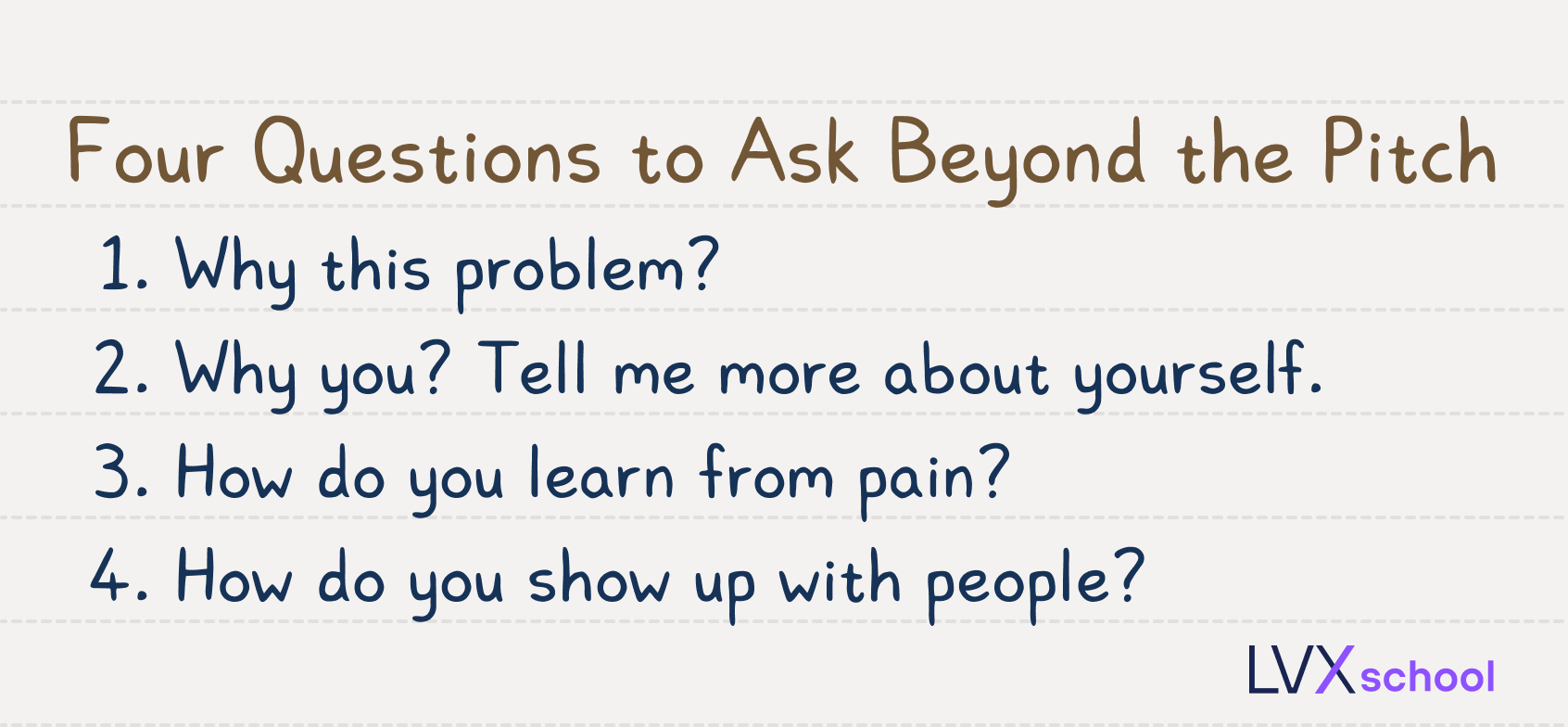
Think of this as a mirror, not a scorecard. For investors, it is a way to observe.
For founders, it is a way to reflect.
1. Why this problem?
Venture is about solving the hard problems - but the key is in understanding the problem in detail.
Do the founders understand the customer in detail? Have they identified the customer persona well enough, and distinguished between the user and the customer?
Can they talk about the problem in simple language? How deeply are they connected to solving the problem?
Is there some lived experience here, or is it just “AI + large TAM + India opportunity”?
Founders who are close to the problem usually speak differently.
They tell stories about specific users, not just market reports.
Red flag for me:
“India’s market is huge, and this is a multi-billion dollar opportunity”
…followed by no depth on who the customer is and what they are struggling with today.
2. Why you?
This is a more personal question, but it matters a lot.
Somewhere in the founder’s story, I’m looking for their right to win:
Is there a personal connection to the space?
Have they worked in this problem area before?
Does their background give them a real edge in distribution, product, or trust?
In my last piece, I wrote about how our childhood and early experiences shape how we trust, love, lead, and define success.
Those same lenses also shape how we build companies.
When a founder can clearly explain:
“This is the problem, and this is why I am obsessed with solving it”
…it changes how I see the whole pitch.
Red flag: a very generic “I like startups / want to build something big” answer, without a clear link between the person and the problem. Some other red flags - “I have been wanting to startup and I see this as a huge opportunity to solve for”
Combining problem and team is my way of evaluating about founder–market fit.
3. How do you learn from pain?
This is where Ray Dalio’s line comes back:
Pain + Reflection = Progress
Every founder has pain.
Markets move. A co-founder leaves. A key hire quits. A round doesn’t close.
What I’m really listening for is not the drama of the story, but the reflection:
Can they talk about a mistake without getting defensive?
What changed in their behaviour after the setback?
Are they able to name their own blind spots?
Founders who only talk about how the world was unfair is a red flag.
Founders who say, “Here is where I messed up, and here is how I run things differently now,” make one lean in to their narrative.
This is the Progress Mindset at work.
4. How do you show up with people?
Finally, I watch how founders show up with people – not just with me.
This is where behaviour across three moments matters more than any line on the cap table.
Three moments that reveal a founder
Over time, I’ve noticed that founders reveal a lot of who they are in three moments:
Before the pitch
In the room
After the pitch
Moment 1: Before the pitch
How they first reach out already tells a small story.
Is the email clear, specific, and respectful of time?
Do they explain why they are reaching out to me, or is it a mass forward? Is it a mailer with all investors in bcc? I typicall never respond to an email when I am in bcc. I also believe that founders who dont have time to research investors before they reach out will demonstrate the same attitude towards their customers.
Did they find a warm connect and get an intro?
Do they send a simple deck, or 40 cluttered slides?
Thoughtful outreach usually reflects thoughtful execution.
Moment 2: In the room
During the meeting, it is not what they say, but how they respond.
I like to watch out for defensiveness in response without allowing questions to be completely asked. These are my metrics for conversations.
Ability to listen and respond is key to long term vision.
Are they willing to say “I don’t know” and then think aloud?
Do they light up when they talk about customers and product, or only when they talk about valuation?
Do they ‘name-throw’ a lot? I had met a founder once who said his right to win was because he was associated with a political party and could get entry into any meeting. For me, that was a deal-breaker.
The room is where you often see whether the ego is bigger than the problem.
Moment 3: After the pitch
The call ends. Sometimes as investors we pass. Sometimes we are unsure. Typically, I dont write a cheque to every founder I meet. But I surely offer help with customer referrals or other intros, if possible. This is where the real founder shows up.
Do they send a short, clear follow-up?
Do they close the loop on numbers or info they promised?
If I say, “Not now,” do they disappear — or do they send a simple update 3–4 months later?
I’ve had founders I did not invest in initially, who kept sending disciplined, honest updates. By the time they were back raising the next round, I had already seen how they handle time, setbacks, and progress.
That behaviour, over time, is often a stronger signal than any single meeting.
For founders: turning the lens inward
If you are a founder reading this, you don’t have to wait for an investor meeting to do this work. Believe in your own story. Investors may not know everything and it is a good practice to listen, engage but drive the businesses based on your own learning.
Here are a few questions you can sit with on your own, or with your co-founder:
Why this problem, in this decade, for these customers?
Why you — what in your story, skills, or network actually gives you a right to win?
What is one painful moment from the last 12 months, and how did you change after it?
If your team described how you show up in the hardest weeks, what would they say?
You cannot control market cycles. You can control how you show up, how you learn, and how you treat people along the way.
Join The PitchRoom WhatsApp
A private learning space for founders, investors, and the startup curious.
No spam. Just real-world analysis, prompts, and frameworks.
Coming up next:
We will summarise all the frameworks, and build a canvas you can use to evaluate startups next time you meet a founder.
Spot on. Reducing people to a spreadsheet is a common trap, especially when trying to understand complex systesm. True insight always comes from recognizing the underlying human motivations.
Your four questions elegantly flip the traditional funnel: instead of TAM-first analysis, you're screening for founder-problem intimacy first. This reframes due diligence from "Is India a big market?" to "Does this person own this problem?" - which I find to be more sustainable.