


Last week, I was at a deep tech roundtable hosted by Startup Baat Cheet. The room was full of founders — some already funded, some already public. As I walked out, one question stayed:
If I met these founders during their first cheque stage, what would I have needed to confidently invest?
That question led to this post.
Deep tech is becoming one of the most exciting (and misunderstood) parts of India’s startup ecosystem. But evaluating these companies is not the same as evaluating SaaS, fintech, or D2C.
There is no:
“Ship fast and iterate”
“Let’s test pricing with a landing page”
Or “What’s your CAC?”
Instead, you are evaluating:
An invention
A researcher or military professional turned founder
And a market that may exist years later
Commercial viability of the solution and if this is a better, cheaper replacement to an existing solution
Yet — when it works, deep tech builds companies that power nations, not just apps. Think defence systems, semiconductor design, new materials, climate tech, aerospace, and synthetic biology.
So the real question becomes:
How do you evaluate something still forming — before the world sees its usefulness?
This is the framework I use as an investor.
Deep Tech: What it really means
Deep tech startups build hard technology, not interfaces.
Areas include:
Robotics and drones
Climate tech hardware (batteries, carbon removal, thermal storage)
Advanced materials and semiconductors
Space tech
Biotech and synthetic biology
AI tools built at the infrastructure level, not “app layer”
A common theme: patents, scientific know-how, and engineering execution matter more than branding or distribution.
The Three Lenses to Evaluate
When we look at a deep tech company, we can evaluate it through three simple lenses:
Technology risk → Market early adopters → Team and execution discipline
Lens 1: Will the technology work at scale?
This is the hardest part.
Many founders can show a simulation or lab demo. Very few can manufacture, deploy, and run the product in the real world without funds.
A useful reference here is Technology Readiness Level (TRL) — used by NASA and now widely used by VCs.
The TRL framework helps to clearly understand the stage at which the startup is operating. Based on your thesis, you can decide which stage you want to invest in.
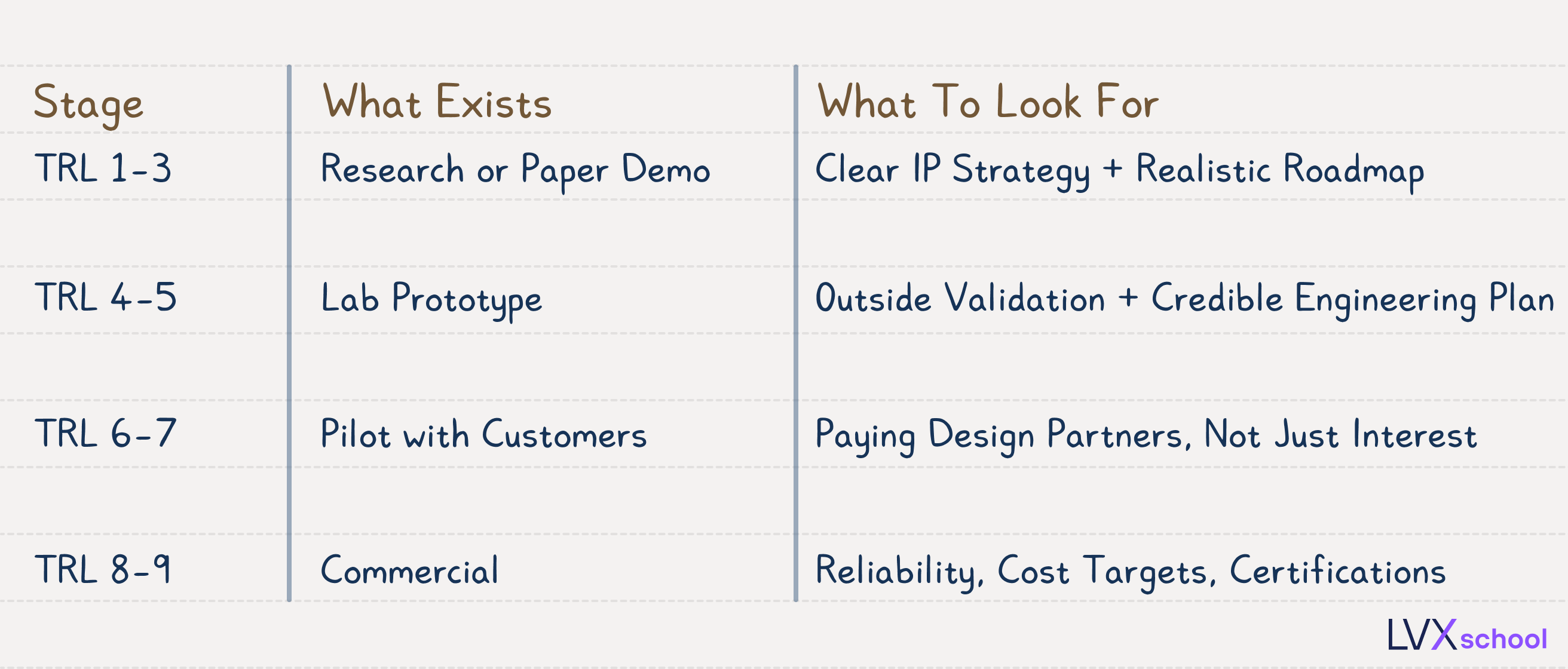
Two questions to always ask:
Has an independent expert validated the claims?
What is the largest unsolved technical risk?
If founders can clearly answer both, it’s a strong signal.
Lens 2: Who needs this enough to pay early?
Deep tech markets don’t start broad — they start with a desperate niche buyer.
Instead of TAM slides, good questions to ask:
Who is the first paying customer profile?
What is the pain? (cost, regulation, performance, safety)
Is there a path to design partnerships with industry?
A climate battery startup doesn’t need 10,000 customers in Year 1 — it needs five industrial partners who are willing to experiment.
That is traction in deep tech.
Lens 3: Can this team cross the “deep tech chasm”?
Deep tech founders are often exceptional scientists — but building a business requires more:
Regulatory navigation
Reliability and testing discipline
Manufacturing partnerships
Commercial understanding and pricing
Fundraising patience
Storytelling
There is one indicator to look for:
Learning velocity — how fast they turn uncertainty into clarity.
Not perfection and Not pitch polish. Just the speed of learning.
A Simple Evaluation Flow
If you are a new angel in this space:
Step 1 — The Quick Filter
Is the problem real and urgent?
Is the technical hypothesis testable?
Is the founder uniquely suited to solve it?
Step 2 — Technical Diligence
Find independent reviewers.
This step is NOT optional.
Step 3 — Pilot Validation
Speak to 2–3 potential design or industry partners yourself.
Step 4 — Milestone-based Investing
Deep tech works best with staged capital tied to technical milestones, not runway comfort.
Where To Look: The India Deal Flow Map
India’s deep tech ecosystem is young but accelerating — and finally, institutions and industry are talking to each other.
If you want to learn or source companies, start here:
IIT Madras Incubation Cell (semiconductors, mobility, materials)
IISc Bengaluru + C-CAMP (biotech + hardware)
These are India’s early deal pipelines. (This is not an exhaustive list.)
Our biggest gap?
Pilot and procurement velocity — especially in defence, energy, and manufacturing.
This is where public–private collaboration will shape our trajectory.
Investor Lens - From the trenches
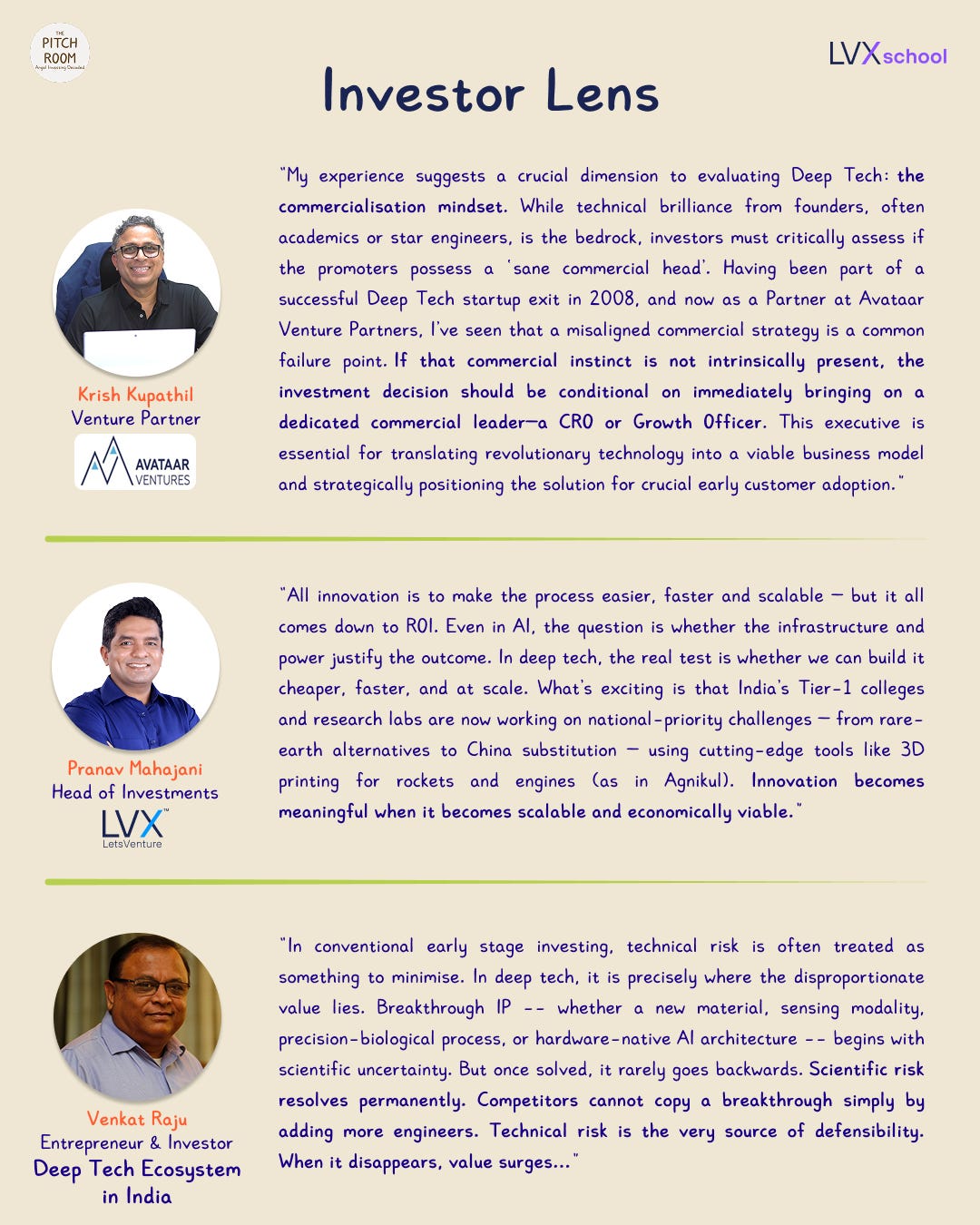
While deep tech evaluation seems simple now, I wanted to get more diverse views. So I spoke to a few investors who have been working with founders in this space, to get their views and create a more complete outline.
Meet Krish Kupathil, a successful exit entrepreneur and now Venture Partner at a growth fund Avataar Ventures, focuses on the “commercial viability of the solution”.
Meet Pranav Mahajani, Public Market to Private Market investor, has led the last 10 deep tech transactions on the LVX platform, talks about “ROI for investors after commercial viability and scale”.
Meet Venkat Raju, Entrepreneur, and Investor in the deep tech ecosystem of India for the last decade. He talks about “Technical Risk Is Not the Hazard -- It’s the Advantage”.
A Closing Thought
Deep tech is slow at the beginning and fast at the end.
Most of the work feels invisible and unglamorous — testing, validation, regulatory filings, supply chain setup.
But when it works, it creates defensibility you cannot copy with marketing budgets.
If you’re an investor entering this space, start small, find domain experts you trust, and build pattern recognition around pilot data and founder mindset.
Join The PitchRoom WhatsApp
A private learning space for founders, investors, and the startup curious.
No spam. Just real-world analysis, prompts, and frameworks.
Deep tech doesn’t only need capital. It also needs belief, runway, institutional support, and a culture that understands long games.
In India, we’re still learning to play long games. But this generation of researchers-turned-founders will be the ones that build what SaaS never could: national infrastructure in private skin.