


Dear Founder Self,
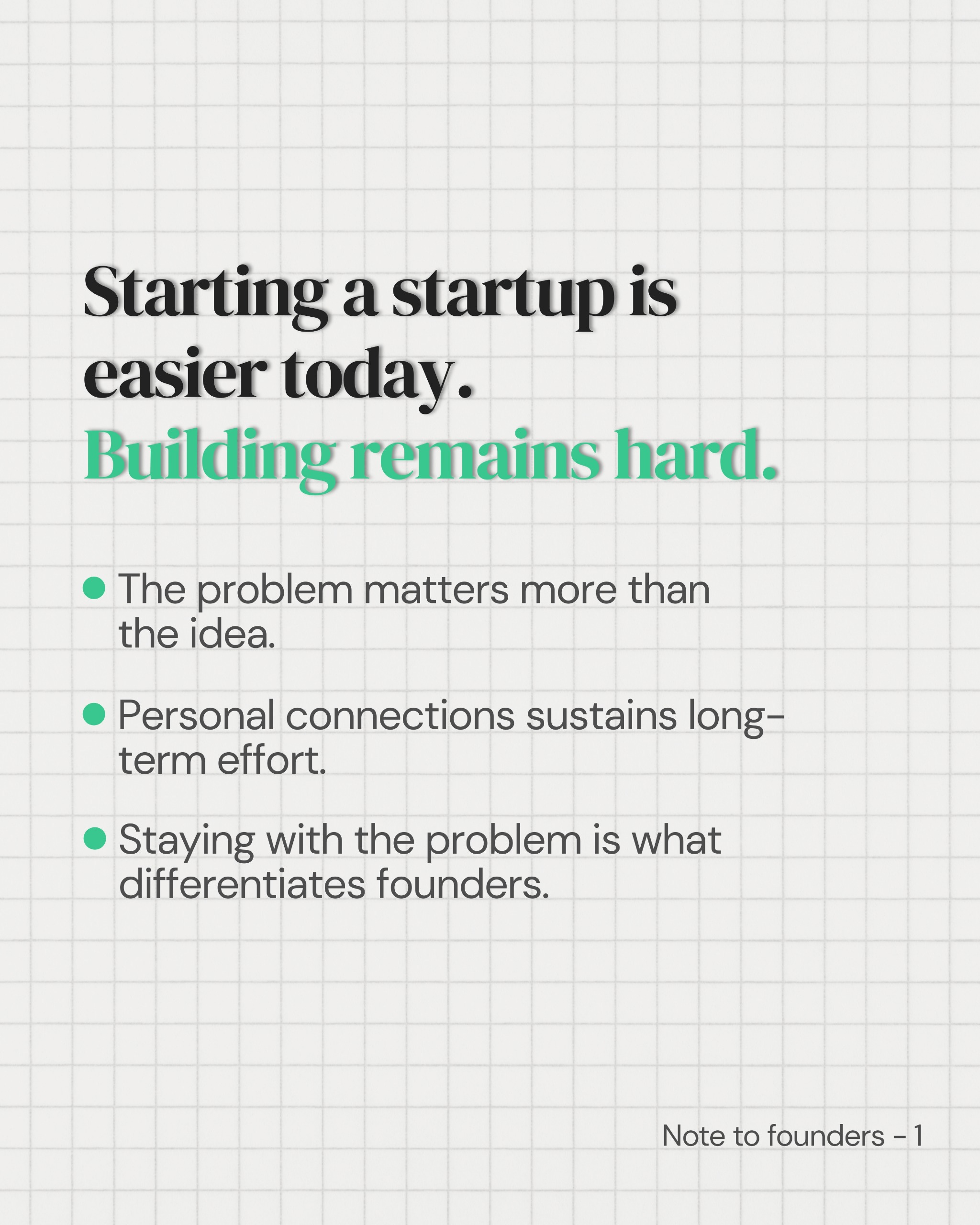
Starting a startup looks easier today than it ever has. But building something that actually works is still hard.
In this note, I am sharing what I wish I had understood before becoming a founder—drawn from years of conversations with founders at different stages.
What has always struck me is that while there is no shortage of information available today, very little of it tells you what the journey actually feels like when you are in it. Most of it is either too polished or too prescriptive.
So I thought I would write a few things I wish I had known earlier—not as advice, but as a way to make sense of the journey from the inside.
I remember this phase very clearly.
Many people seek meaning through work, not just income, as explored in Man's Search for Meaning. This is one of my all time favorites.
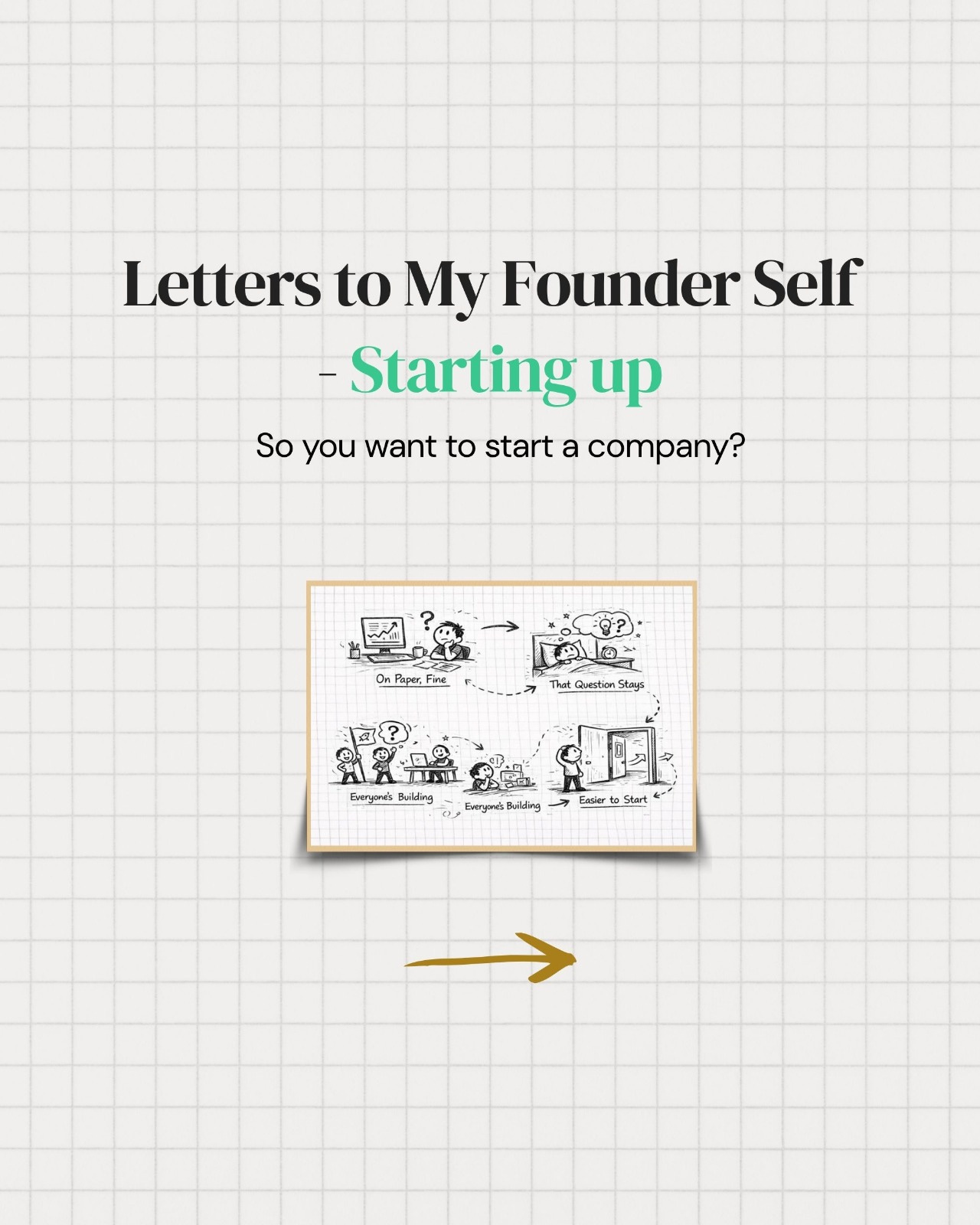
Once wealth is created, we all at the core. crave for the meaning we can create. It usually begins with a certain restlessness. On paper, everything looks fine—your job, your team, the direction you are headed in. And yet, there is a part of you that keeps asking if you should be doing something of your own.
That question stays with you.
What has changed over time is the environment around that question.
Why more people are starting up today
Today, starting up feels far more accessible than it did earlier. You see people building everywhere. A friend has raised a round. Someone you follow has built a meaningful business with a very small team. Technology has reduced the friction to start, and in many ways, that is a good thing.
But it also creates a certain pressure. A feeling that you should be doing this too. That is not always a good enough reason.
The difference between starting and building
Because while it has become easier to start something, it has not become easier to build something that matters. The gap between a project and a company is still very real, even if it is less visible at the beginning.
Start with the problem, not the idea
So before you take that step, it is worth pausing for a bit longer than feels natural.
Not to overthink, but to understand what is actually pulling you towards this.
The first thing I would ask you to reflect on is the problem you want to work on.
Not the idea you have in mind, but the problem itself.
Understanding the problem: What is the person you are building for doing today, without your product? How are they solving it right now? And why has that solution continued to exist?
Most problems are not unsolved. They are simply being managed in ways that are “good enough.” That is what you are competing with.
If your product were to exist, would it change that behaviour meaningfully? Would it make something easier, faster, or more reliable in a way that they would notice—and come back to without being reminded? Would someone pay for it, without having to debate the benefits?
If that is not clear yet, it is possible that you are still at the stage of having an idea, not a problem. That distinction matters more than it seems.
Your personal connection to the problem
The second thing is more personal, and therefore a little harder to sit with.
Why do you want to work on this?
Not in a broad sense, but specifically—what is your connection to this problem? Have you experienced it, or spent enough time close to it to understand its nuances?
The founders who stay with a problem long enough to build something meaningful, usually have a certain closeness to it. It shows up in how they describe it, in the questions they ask, and in the patience they have when things do not work immediately.
If your answer is primarily that it is a large or growing market, it is worth pausing here.
Markets create opportunity, but they do not sustain effort.
Something more personal usually has to do that.
Will you still care in the long run?
The third thing is a question you can only partially answer now, but it is still worth attempting.
Will you still care about this nine months, nine years from today?
Because the experience of building will change. The initial excitement will settle. The conversations will reduce. There will be long stretches where progress feels slow, and moments where things you were certain about begin to feel less clear.
There will be a period where nothing seems to move. That part is rarely spoken about, but it is real.
And in that moment, what keeps you going is not excitement. It is a quieter kind of commitment to the problem itself.
If you feel that you will stay with it even then—not because it is working, but because it still feels worth solving—you are closer to being ready than most.
There is also something else that does not get discussed enough.
As a founder, you spend a lot of time in ambiguity. There will be phases where the data is incomplete, advice does not align, and the right answer is not obvious. Some people grow into this over time. Others find it draining.
It helps to know which one you are.
None of this is meant to make the decision harder. In some ways, starting has never been easier. The ecosystem is more supportive, the tools are better, and access to knowledge is far greater than before.
But staying with it is where the real work lies.
It will ask more of you than you expect—not just in effort, but in patience, resilience, and sometimes your sense of self. So the reason to begin has to be strong enough to carry you through that.
In the end, most founders do not start because the timing is perfect or the tools are available. They start because there is a problem they have come across that they cannot ignore anymore.
And they stay with it longer than most people would. That is usually enough.
More soon,
Shanti
The statements are so True - "The difference between starting and Building". These are very powerful words for Startup Founders- specially Building and staying with the Problem.
Good to read such a powerful article in a sunny Sunday Morning...
Hasn't it always been,to sustain the startups and achieve higher skies and breaking the limits of the startup buisness and what it could be as a company.