
I read this article on Business Today over the weekend and I had to write a more detailed post breaking this down.
Shekhar Daga, Head of Private Capital at ICICI Prudential AMC, told BusinessToday this month that HNIs should default to a 40% listed equity / 40% listed debt / 20% private capital portfolio, with India’s alternatives industry growing roughly 25% annually over the next decade. You can read his full case here: BusinessToday, Sept 12, 2026.
I’m not going to re-walk his argument — it’s a good one, and it’s his to make. Why am I discussing this here? Because finally we are officially talking about alternate asset allocation more publicly. For the longest time, I have seen HNI’s refusing to allocate to this asset class. I agree the space is complex if seen from the outside, but once you start to engage, you realise that not having an allocation is not a good strategy. (you can start with lower than 20 if needed)
Having said this, I want to answer the question the proposed framework leaves open. That 20% doesn’t just mean “some private capital.” It includes private credit, real estate, and startups, all sitting under one label. If you’re allocating any of it to startups, the next question isn’t how much — it’s how much to which kind.
Because “startup investing” isn’t one asset class. Early-stage, growth-stage, and secondary are three different bets, with three different risk profiles, three different holding periods, and three different jobs to do inside a portfolio. Treating them as a single line item is how a 20% allocation ends up looking diversified on paper and isn’t.
In India, we see this at 5-7% (from the 20%), thought more active investors allocate as much as 40%. Internationally the numbers skew to as high as 30%.
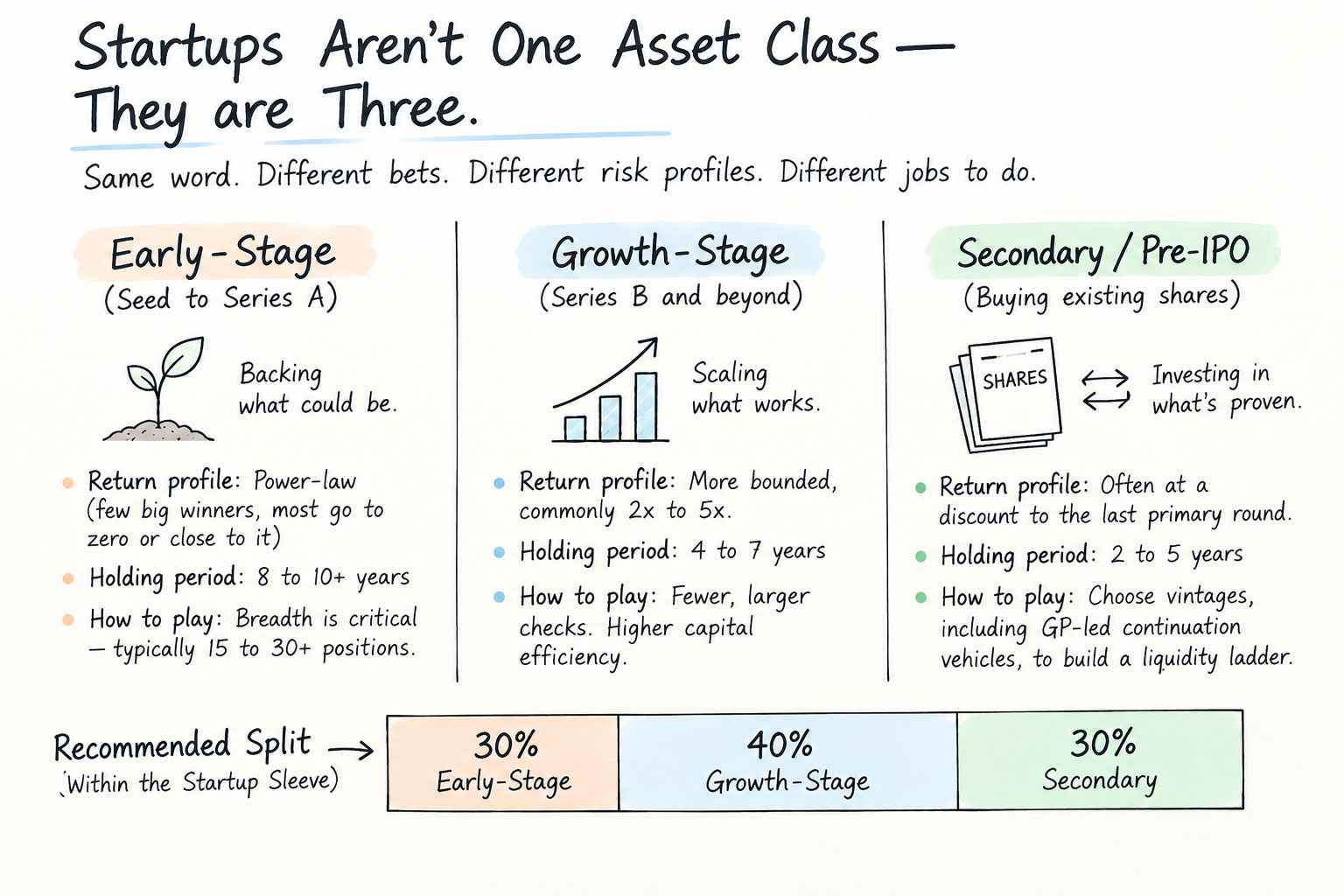
Startups Aren’t One Asset Class — They are Three
Most allocation conversations stop at “how much goes to startups.” That’s the wrong resolution. It’s the equivalent of an equity allocation that doesn’t distinguish between a pre-revenue small-cap and a blue-chip index fund — technically both are “equity,” and that fact tells you almost nothing useful.
Early-stage means seed through Series A: a founder, a thesis, and not yet enough revenue history to underwrite the business on numbers alone. Growth-stage means Series B and beyond, up to pre-IPO: the company has already proven a model works and is now proving it scales. Secondary means buying shares that already exist — from an early investor, an employee, or a fund needing liquidity — in a company whose traction, revenue, and often its last two or three valuation markers are already on the record.
Same word, “startup.” Three completely different underwriting problems.
Why They Behave Differently, Not Just Earlier or Later
Early-stage is a power-law business. A small number of positions carry the entire portfolio’s return, most individual bets go to zero or close to it, and the only way the model works is breadth — 15 to 30-plus positions, minimum, so the winners have room to do their job. Time horizon runs 8 to 10-plus years. The upside is uncapped; so is the mortality rate.
Growth-stage is a different shape entirely. Fewer companies in this bracket fail outright — you’re underwriting a business with real revenue, not a slide deck — and outcomes cluster in a more bounded range, commonly 2x to 5x rather than 0x or 20x. Capital efficiency is higher too: fewer, larger checks instead of many small ones. Time horizon is shorter, typically 4 to 7 years, because the company is closer to an exit event of some kind by the time you enter.
Secondary is the most visible bet of the three before you even write the check. You can often see the growth trajectory, the last primary round’s price, and sometimes the buyer’s own target return before committing — and pricing frequently comes at a discount to the last primary round rather than at a premium. Holding periods run 2 to 5 years, shorter than either of the other two, because you can choose vintages that are already closer to their own exit, or enter through GP-led continuation vehicles built around a defined return target and timeline.
Early stage is a venture bet on the future. Growth stage is a growth bet on execution. Secondary and pre-IPO is a liquidity-aware bet on something already proven. None of those is a substitute for either of the others.
Recommended Split Inside the Startup Sleeve
Based on our own internal learning, as well as what we have heard from mature HNI’s and family offices who have been investing into private markets, inside their 20% private-capital allocation, the default recommended split is:
40% growth-stage. 30% secondary. 30% early-stage.
The logic follows directly from the risk shapes above. Growth-stage is the anchor — the largest single slice — because it carries the most bounded, most underwritable risk of the three, and the shortest realistic path to an exit event. Secondary sits second, not as an afterthought but as a deliberate liquidity ladder: capital entering at known valuations, on vintages you can choose to stagger, gives a portfolio visibility into when distributions might actually arrive, rather than every dollar being locked to the same uncertain horizon. Early-stage gets the smallest slice, not because it matters least, but because its power-law nature demands small position sizes and real breadth to work — a large check into one seed-stage company isn’t diversification, it’s concentrated risk wearing a growth story’s clothes.
This is a default, not a formula. Daga caveated his own 40/40/20 the same way — “depending on individual circumstances and risk tolerance” — and the same applies here. A founder-adjacent HNI with a longer time horizon and real conviction in specific sectors might run the early-stage slice higher. Someone closer to needing liquidity from this sleeve within five years should probably run secondary higher and early-stage lower. The split is a starting point for a conversation with your own risk tolerance, not a rule.
The Structural Case for All Three Growing Together
This isn’t a case built on optimism alone. India’s Category II AIFs — the vehicle housing most early-stage, growth-stage, and secondary-adjacent strategies — drove more than 92% of the AIF industry’s ₹1.20 lakh crore quarterly increase, part of total commitments reaching ₹16.94 lakh crore as of March 2026, up 25.6% year-on-year (Cafemutual). That growth isn’t concentrated in one tier — it’s structural demand showing up across the category.
Here its good to note that while private credit falls into the same startup category, it had a flat H1 2026 — $3.5 billion deployed, barely above H2 2025’s $3.4 billion (EY-India). Not every sleeve inside “alternatives” is accelerating at the same pace, which is why the split matters more than the label — “alternatives” as a category is not one uniform growth story.
On the demand side: India’s UHNWI population is up 63% since 2021, to 19,877 people, the world’s sixth-largest such population (Knight Frank, via MediaBrief).
Asset Allocation - Plan for the 20% growing segment
If you are an HNI, ensure that your wealth manager is being more deliberate about the allocation split. In my experience, many wealth managers ignore the startup space and only focus on private credit, as this is still a less understood, more complex asset class. Access and curation is key, and many good transatcions close based on relationships and founder proximity. I want to reiterate that growth-stage, early-stage, and secondary are three different tools doing three different jobs: an anchor, an upside tail, and a liquidity ladder.
If you already have startup exposure, don’t ask “how much is in startups.” Ask what’s actually in each of the three buckets — and whether that split happened on purpose, or by whatever deal happened to land on your desk this year.
Happy conscious investing!
Shanti