


Honestly, today there is no shortage of content on public market allocations.
Asset allocation, SIPs, retirement math, portfolio balancing — everything is structured. If you even google it once, you will be given multiple options on how to plan yur investments. There are platforms that then allow you to follow structured investments.
Startup investing is the opposite. The lack of visible formulas and structure makes it more alluring.
It is mostly reduced to one line:
“Invest what you can afford to lose.” I am guilty of this too. I would often over simplify startup investing to this: “Write the cheque, and write it off”.
Honestly, that is not a framework. That is a disclaimer.
Startup Investing: Neither a side bet nor your main bet
I have many friends who ask me a a version of this:
“How much should I allocate to startups?”
The answers are usually broad.
“10% of your net worth.”
“Only invest what you can afford to lose.”
Both are directionally right. Neither helps you act.
So I finally decided I would write a post to make this more concrete and understandable.
Case 1: You earn ₹2 crore a year
After taxes and lifestyle, most people will have:
₹50–60L as annual savings for investing
This becomes your investment pool. The real question is:
“How much risk do I want to take within this pool?” This is purely personal. I have seen people who work in startups allocate as much as 50% into startups. That is NOT the norm.
How do you deply your ₹50–60L as investable corpus?
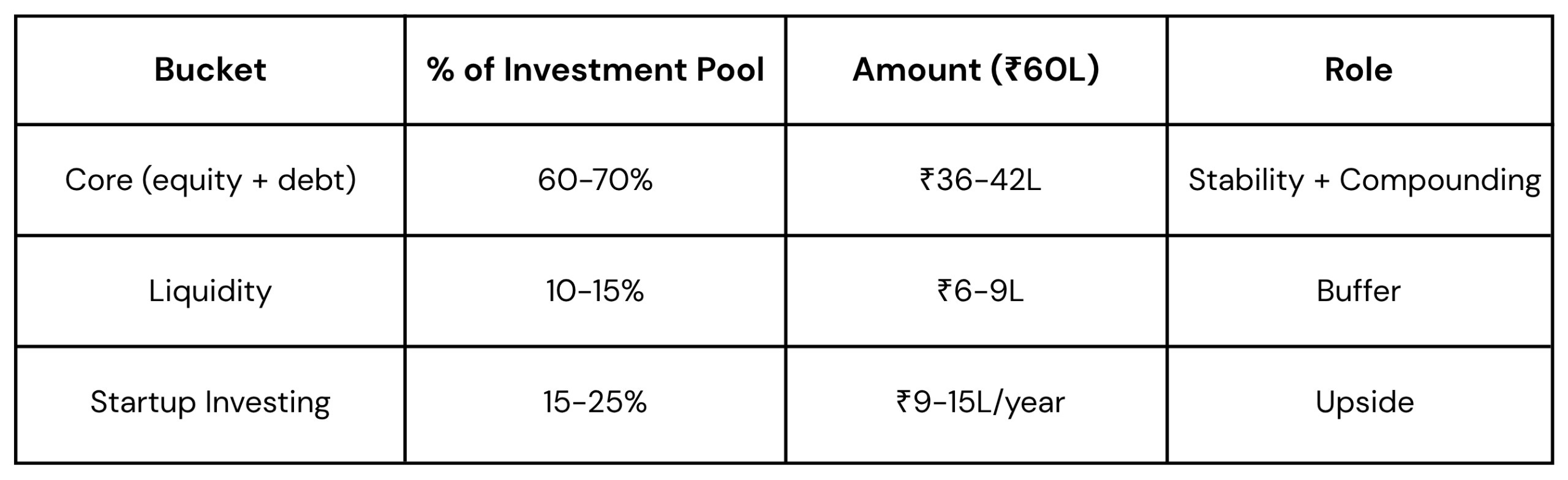
This is where startup investing becomes meaningful, but not reckless.
How to deploy this ₹9–15L annually towards startups:
This is where most people get it wrong. They do 2–3 deals and stop. That is not a portfolio.
A more disciplined approach:
* 3–5 startups per year
* ₹2–3L per startup
* Over 4–5 years → 15–20 startups
Now the math starts to work. This is when outcomes start to look less random. The first few cheques can be smaller cheques, so you start to understand the process, and also trust your own judgement.
Case 2: You have ₹5 crore investment corpus
Now the question shifts.
From “how much to invest”
To “how to allocate without damaging what you have built”
This becomes your startup allocation pool.
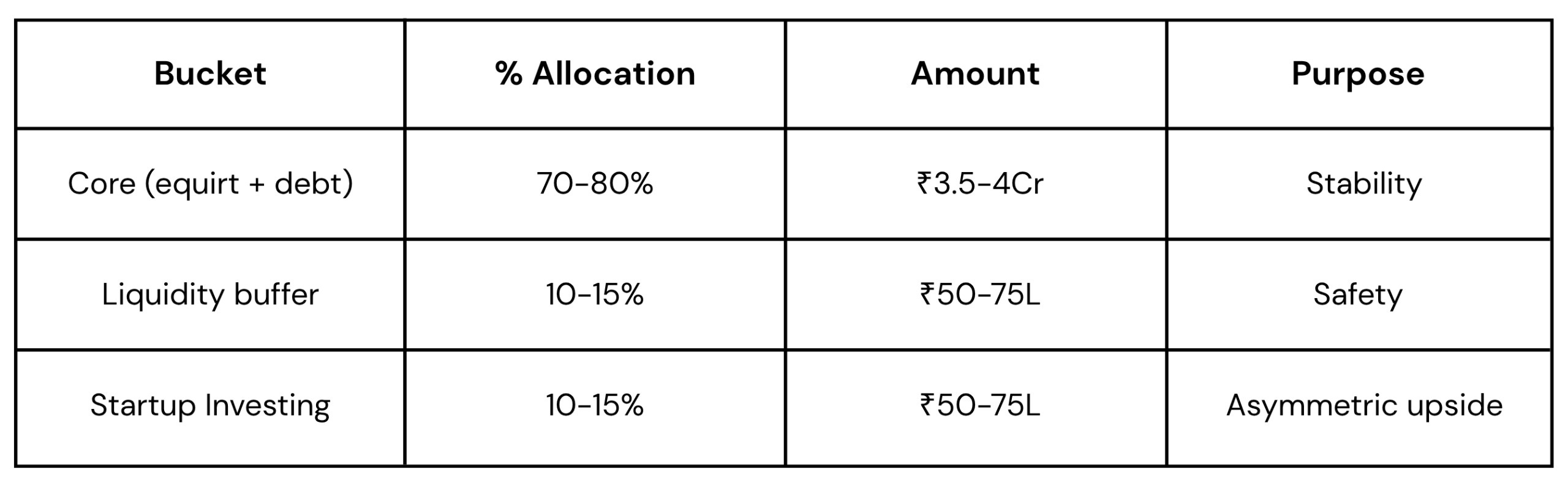
How to deploy this startup allocation corpus
Spread over 3–4 years
15–20 startups
Keep 30–40% reserved for follow-ons
Example:
Initial cheque: ₹3–5L
Follow-on: double down on the top 20–30%
Where most people go wrong
They treat startup investing like experimentation.
“Let me try a couple of deals.”
That almost guarantees weak outcomes, because returns here are not linear. They come from a few outliers. That is the truth and the faster we understand this, the better investors we start to become.
A simple formula to remember
Startup Allocation = 10–15% of your investment pool
Portfolio Size = 15–25 startups
Time Horizon = 8–10 years
If one of these breaks, the model weakens.
Why this matters for founders
Founders often ask:
“Why did this investor pass?”
It is rarely just about the startup.
It is often about:
how many similar bets they already have
how much capital they have left
whether they are pacing investments
where this fits in their portfolio
In short, allocation as Howard Marks says,
“You cannot predict, but you can prepare.”
Allocation is preparation.
The shift that matters
If you are an investor, do not ask:
“Is this startup good?”
Ask:
“Does this fit into a portfolio?”
This is the layer beneath startup investing. And it is worth understanding — whether you are deploying capital or raising it.
If I had to give every new investor one page, this would be it
Call it a simple operating guide for startup investing:
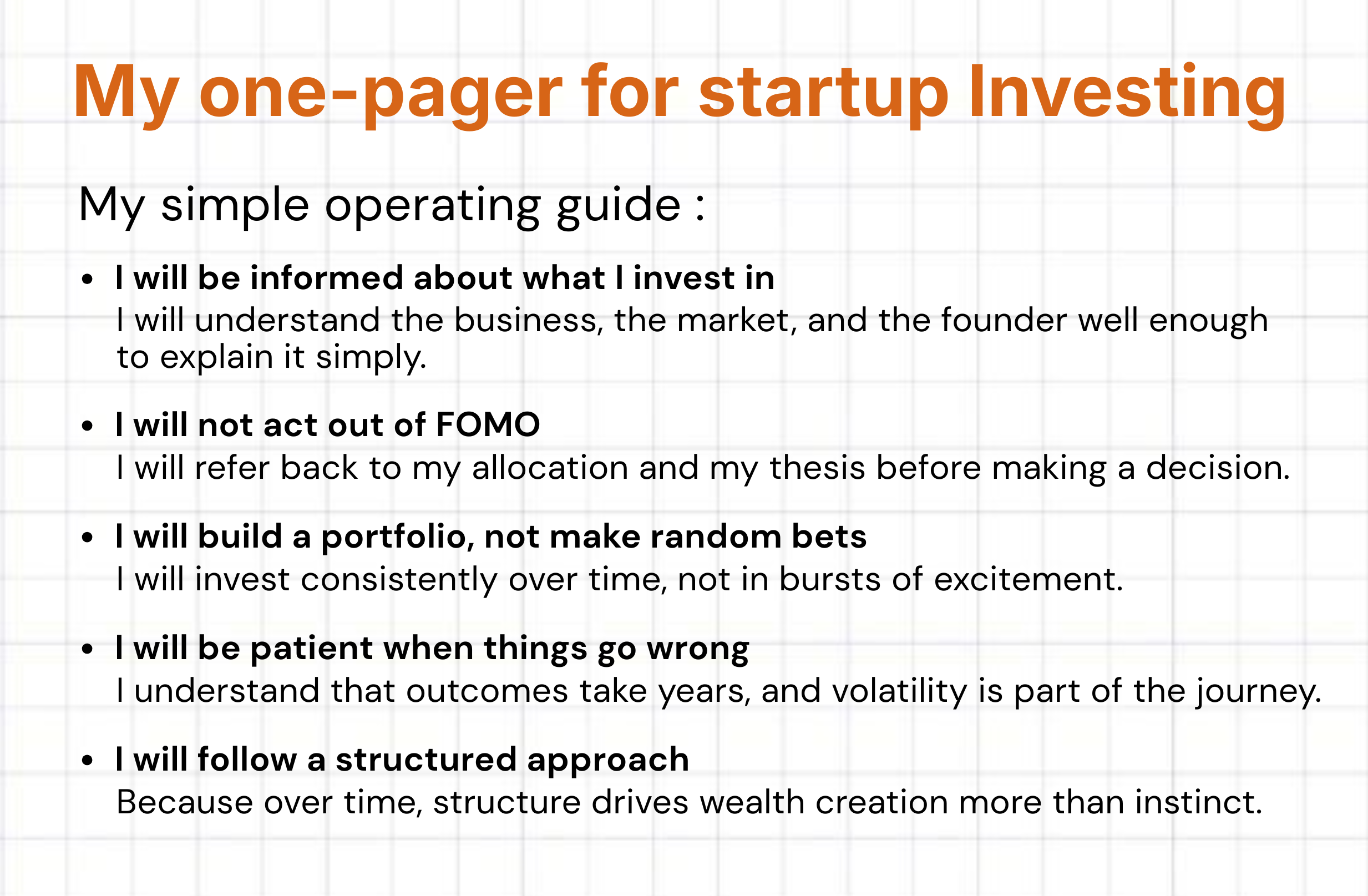
In closing, just one rule to remember:
In startup investing, discipline compounds faster than returns
Hope this makes angel investing more understandable and quantifiable.
If you are a founder wondering why investors passed — re-read this. The answer is usually in their portfolio, not in your deck.