


I was in a serious discussion with a friend, on a subject we could not seem to agree on. And he turned around and said: “I don’t know why we are arguing so much. I don’t like conflicts”. How do you respond to this? Honestly, I don’t know anyone who likes conflict. This I thought was passive aggression on how we manage difficult conversations - times when we don’t think we will win, or where we believe there is a fundamental difference which is hard to bridge. Passively allow the conflict to stay unresolved.
How we respond to conflict, and how we process the difference is always based on how much we stand to gain or lose . However, I personally think conflict is the only way we are challenged to alter our world opinion on many topics.
Facing Conflict is like wisdom - we don’t receive wisdom, we discover it for ourselves.
Managing conflict is a skill we acquire, from life experiences, and deep rooted in our own context.
Founder (Mis)Fit ?
Team is probably the #1 deciding criteria when investors look at writing a cheque into startups. Having been in startups for almost most of my working career, I have seen founders present their team with “We have worked together for the last 10 years”, “We are childhood friends”, “We have always been hustlers in college” - all data points leading to a high emphasis on team DNA. Unfortunately I have also not seen any of this help when the cracks start to appear.
As founders, managing conflict is probably one of the key skills you will have to develop. I think this skill is underrated and not discussed enough.
Managing conflict as founders is as important as our ability to find product market fit!
No one tells you how hard it is to be a founder - there are small conflicts , big conflicts and some that could break the institution you are trying to create. Not every conflict is written about, and not every conflict could be seen directly related to the startup failure. However, an interesting statistic based on some studies has shown that 70% of startup failure is caused by co-founder disputes, and these conflicts can lead to a number of negative outcomes, such as delays in product development, lack of direction, and an inability to raise funding. Founder conflict can also lead to a lack of trust and communication among the team members, which starts to create a toxic work environment.
Answer the “Why”
Why you are a founder, and aligning on the why becomes critical to how we manage conflict. While it may seem obvious in hindsight, it is never obvious when you start a company. Call it the rush of enthusiasm or the early signs of love for the idea you are building, everything around starts to look rose tinted. I have personally experienced this in multiple instances.
I’ll share some instances of real-life scenarios that are interesting use cases to learn from. There are no right or wrong answers here. Just some key takeaways.
In one startup, an external mentor was bought in to discuss how the founding team of 4 thought of exits, and their motivation of being part of the venture. We went around the table and every founder spoke about his motivation. There was money, value creation, learning - some of the common reasons that came up. But the CEO said he was doing this because he wanted to be CEO, with almost a subtle admission of the power he enjoyed being in the role. The discussion ended but there was a clear evidence of misalignment of goals. Within a month of this discussion, 2 of the 4 co-founders exited the startup. Was there an open conflict? No.
Conflict need not always be dysfunctional with loud arguments and active aggression. It could also be conflict in goals and how we prioritize where we want to commit our energy.
Answering the why becomes critical to ensure there is a fundamental alignment in why you are founders together. I cannot emphasize enough on this, and how this is such an undervalued discussion.
I have also come to believe that as humans we try to avoid having this conversations until compelled to. We fear what our inner voice would tell us - we learn to quieten that voice, for the fear for being labelled illogical. I know for sure that when you ignore the smaller signals, the signal does not go away. It just lies dormant till a larger issue surfaces.
Answer the “Who”
Who plays what role becomes very critical as founders start to build.
In my experience, the role definition not being discussed and agreed on is possibly one the major unsaid reasons for conflicts.
While no one wants to look like the role is important, it ultimately becomes one of the key areas of conflict.
An instance where I saw this play out was when an investor, who had committed early on met the founders to sign off the term sheet. Everything was agreed on and a simple question of “who among you is the CEO?” led to a debate among the founders. The investment did not go through as the investor realised there was fundamental misalignment and cracks would eventually develop.
There are also instances when the attention the CEO gets at the startup with all the media attention, customer attention and investor attention tends to leave other founders in the background. This starts to create differences, as well as perceived diminishing value for others. Answering the Why honestly can help avoid conflicts going forward.
Debate, Disagree till you commit
As founders, one thing you learn, is life everyday is hard. There could be hard days, harder days and hardest days! It requires you to be plugged in every moment, to ensure you are building something meaningful. With busy days, we don’t realise the energy it takes to watch out for alignment and ensure that trust is maintained. Over time divergence in actions could also be treated as disagreement, if not managed well.
One of the core values we have in my startup is to that we agree to debate and disagree till we commit. Once we commit, there is no democracy to change decisions. There is no passive aggression. In my experience, this is the beginning of conflicts that slowly start to build, as commitments are not honoured.
Founders brains are wired to demonstrate autonomy. This needs unlearning and unwiring!
Build an ecosystem outside the workplace
As a founder, look at your fast dial list. Is it everyone from work? Is it everyone who works for you? Are there only people from your own profession?
My key mantra is find people in your inner circle who don’t know what you do for a job, and who are not in the same vortex of professional achievement.
This is the only way you will know how small you are in the larger context - when you realise that the world does not wait and will not wait for you. This might sound harsh but that is the buddhist philosophy that applies to work too.
Find friends who will love you, not for your work and not for your title. Facing and addressing conflicts becomes so much more easier when you can find the few people who can be unconditional about your life - when you know you are supported.
Sometimes no one wins
Some conflicts can never be resolved. That is the reality. Everyone seems right in their own view, driven by their own Why, their own style, their own context and their own motivations. I have seen startups shut down because there was no resolution - founders were willing to lose it all so that the other does not win. No amount of conversation, or mediation worked. A great tech product,good product market fit, money in the bank but two warring sides and everyone lost. Employees, shareholders, founders as the company shutdown and money given back. It was a matter of not able to find the middle ground.
Watching this happen, and having played the role of mediator, I realised that we over simplify solutions for the human mind. Every management book teaches you tools to address conflict but no one teaches you the psychology behind decisions, and how the self becomes larger than everything. And how we tell such wonderful stories that justify everything we did on the path of self destruction. I have learnt that everyone has a choice. However these choices are personal and cannot be rationalised, explained, controlled or managed.
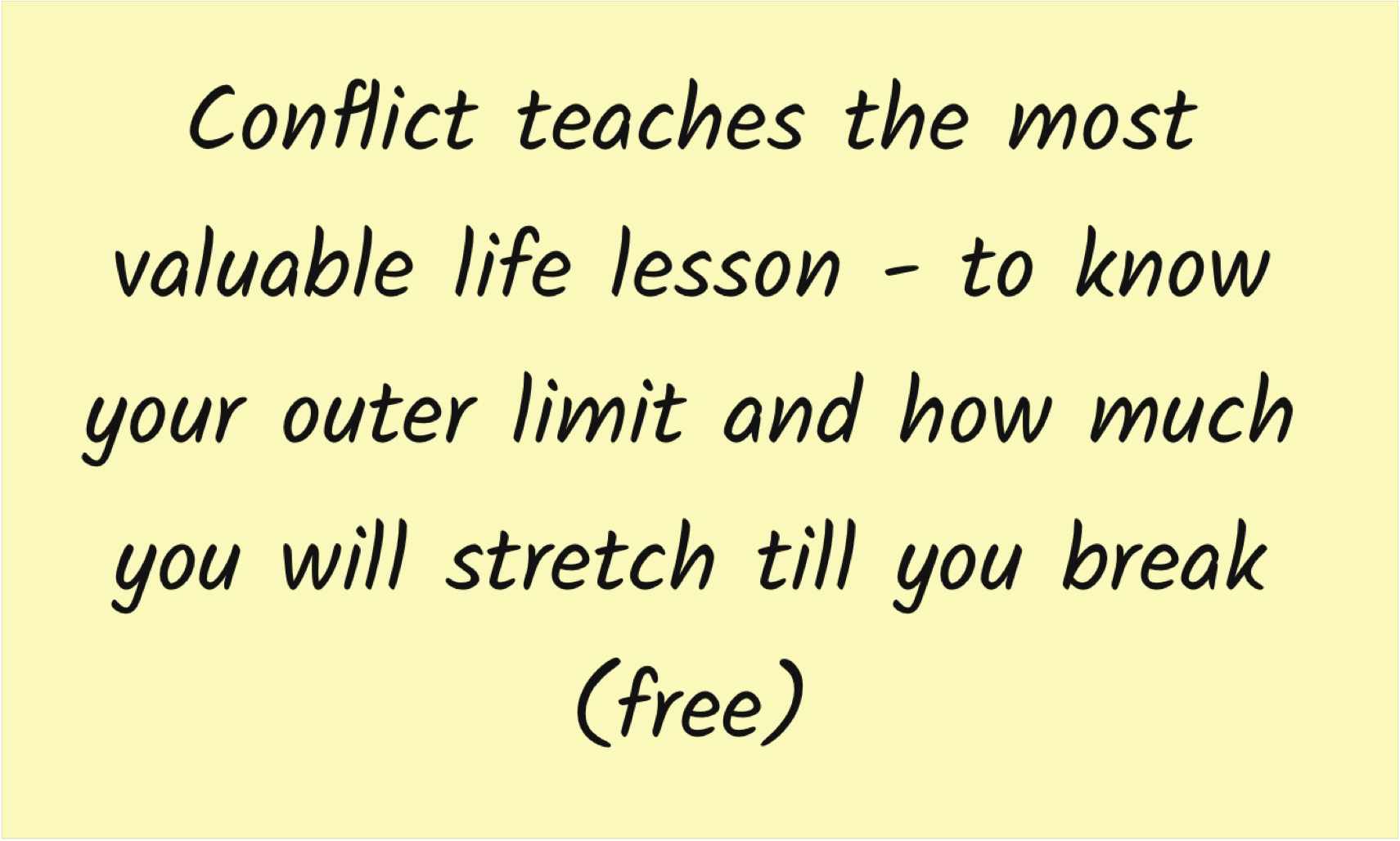
Only when you risk going too far, will you know how far you can possibly go.
Can we all win?
Can we use conflicts to learn our blind spots, learn to face our own inner demons and learn the lesson of impermanence? Next time there is conflict, learn to retreat into silence and listen to your inner voice Force yourself to ask this question on Why, and Who won? Maybe the answers will tell you more than any mentor or management book can teach you.
Conflict management is more about knowing yourself than proving a point. As they say, learning is the only constant in life!
Very interesting perspectives about conflicts. I would say healthy conflicts and unhealthy conflicts along with visible and invisible dimension.
I quickly reflected on one of recent conflict and clear see my outer limits and where to stretch till higher limits.
Thank you for sharing great blog post.