


Last week, I attended a meditation retreat. It was also a spiritual retreat. I belong to a spiritual school where the annual retreat is a time to pause, review one’s approach to life, and create a more thoughtful plan for the year ahead.
There were close to 4,000+ people in the hall. Over the days, as I sat and observed, one thing became impossible to miss. The room was overwhelmingly female. By my estimate, nearly 80 to 90 percent were women. The men who were present were clearly fewer.
I could not but help compare this to the investor events we run at LetsVenture. Conversations around capital, companies, growth, and returns. In that room, the numbers always flip entirely. If there are a hundred people, maybe four or five were women. I see this contrast often. The faces change, the cities change, countries change but the pattern stays stubbornly the same.
And it makes me pause.
Because this is not about women being unfamiliar with money. Women run the finances of most households. They think deeply about savings, security, education, healthcare, and risk. Yet, when money becomes formal—when it enters public rooms, balance sheets —women quietly disappear.
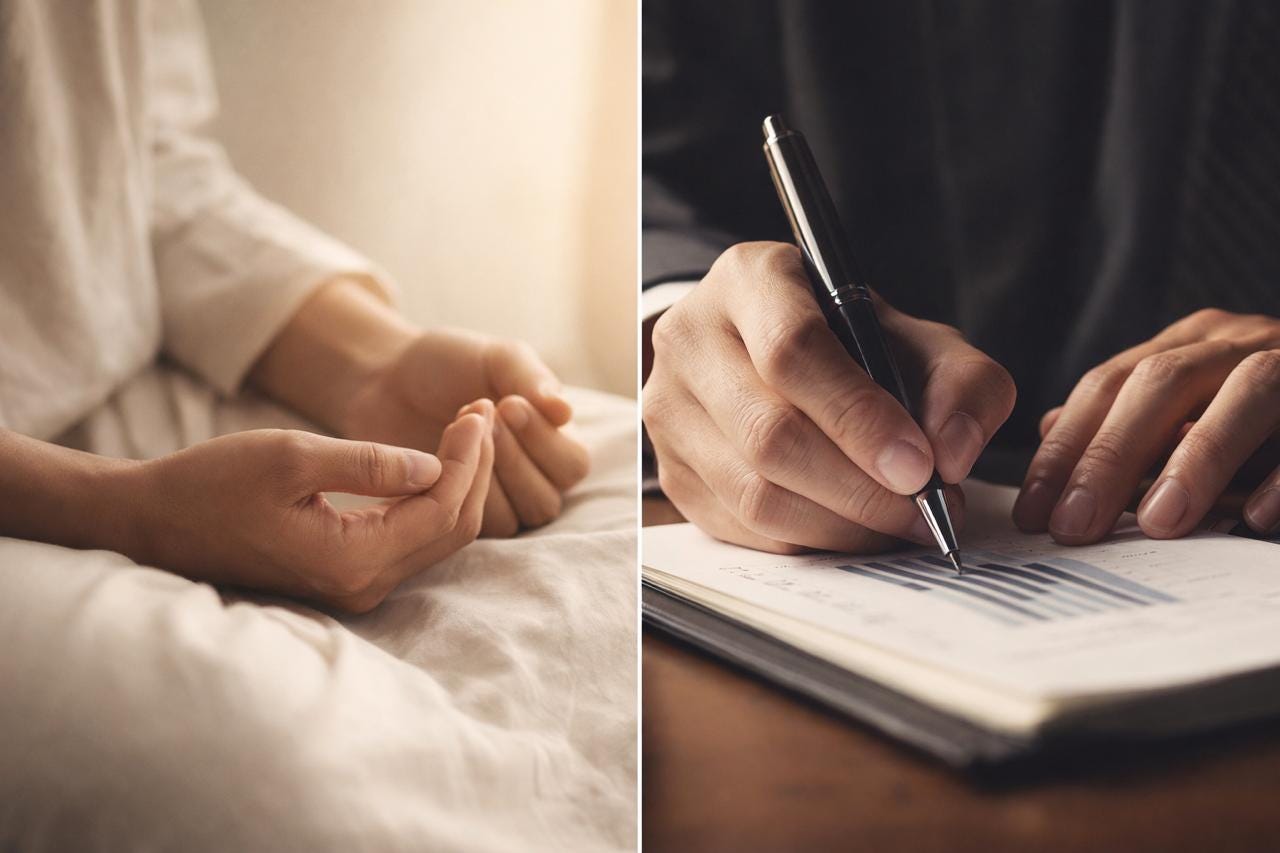
At the same time, meditation halls and spaces of inner work are full of women. With all the awareness around mental health and inner work, there are very few men who show up. Interestingly, many of the most visible spiritual leaders in these spaces are men.
This inversion is not accidental.
Yin and Yang in everyday life
In Eastern philosophy, Yin and Yang are not opposites in conflict. They are complementary forces. Yin represents inward energy—reflection, continuity, care. Yang represents outward energy—action, assertion, expansion. Neither is superior. Balance is the point.
When I look at these rooms, I cannot help but see this play out in modern life.
We often explain these patterns as preference or choice. But the more I reflect on it, the more I wonder if what we call choice is actually something far older—conditioning
Is this really about choice?
In Sapiens, Yuval Noah Harari writes about how much of human behaviour is shaped by shared social roles created for survival, not fairness. Early Homo sapiens societies divided responsibility.
Women were associated with continuity and the inner life of the group. Men were associated with confrontation, negotiation, and the outer world.
Those roles were practical once. Over time, they hardened into identity.
Today, hunting looks like capital allocation. Territory looks like markets. Negotiation happens in boardrooms instead of forests. The inner world has found new spaces—therapy rooms, meditation halls, retreats.
The roles changed form, but not entirely their emotional memory. Even when none of this is explicit, the body remembers centuries of cues.
This is not weakness. It is adaptation.
Men, too, are conditioned—often away from inner work and towards external validation. Many arrive late to emotional self-understanding, not because they lack depth, but because they were taught that depth mattered less than dominance.
A subtle shift worth noticing
There was one more detail from the retreat that stayed with me. The men who were present were mostly younger. There were very few older men in the room.
That felt important.
Many of the younger men were there with their partners. They seemed to recognise that a spiritual journey together can strengthen bonds and build more equal, respectful relationships. I found that deeply encouraging.
If conditioning was learnt over generations, perhaps it can also be unlearnt—slowly, unevenly, but meaningfully.
Women have been entering public and economic spaces for decades, even if progress remains incomplete. And now, perhaps, younger men are beginning to enter inner spaces with equal seriousness.
Not a reversal. But a loosening.
A Republic Day thought
Republic Day reminds us that equality is written into our Constitution. But lived equality shows up more quietly—in where people feel they belong, where they feel confident enough to take up space.
Real freedom is not only political. It is psychological. It is economic. It is deeply personal.
It shows up in the rooms we enter without shrinking.
Perhaps the work ahead is not just representation, but reconditioning—for women and for men. Allowing both to occupy the full range of human experience: power and vulnerability, authority and reflection.
That feels like a Republic Day question worth sitting with. Not a question to ask on Women’s day and forget about it.
A small invitation, if this resonated
Over the past few years, as I have built and invested, I have also been writing.
I am currently working on a book on private market investing— to simplify how we think about money, risk, and decision-making. Especially for those who have stayed away from financial rooms not because of lack of ability, but because the language and culture felt unfamiliar.
If you are reading this and these reflections resonated, I would love your help.
I am putting together a small Advanced Reader Circle—a private group of early readers who will get access to the draft chapters and share feedback as the book takes shape. In return, you will be acknowledged in the book for your contribution, and you will help shape something I hope will make private market investing more accessible and grounded.
If this interests you, you can join the reader circle here:
It feels fitting to extend this invitation here, on Republic Day. Because access to financial knowledge is also a form of freedom.
And like all freedoms, it grows when it is shared.
Totally agree. The AY retreat was indeed a game changer. Nice to meet a fellow practitioner :)