
Starting without a startup in mind
Finding the right startup idea is rarely a straight path. Most founders do not start with clarity—they arrive at it over time.
When I look back at how I started, it is quite different from the neat stories we tend to tell about companies. When I returned to India, I had no plans of starting up. I had already founded a startup, had worked at a large corporate and I was quite clear I wanted to work in the impact space. I wanted to do something meaningful, and that felt like the most direct path at the time.
But as often happens, what you set out to do and what you end up doing are not always the same thing. Destiny, luck and serendipity are real!
The first signal: a broken system
As I began spending time with nonprofits and trying to help them raise funds, I started noticing something that felt off. The process of fundraising itself felt broken. Not in a dramatic way, but in a very operational, everyday sense. It was inefficient, repetitive, and heavily dependent on individual conversations.
I found myself saying the same thing again and again to different people. The same story, the same context, the same explanation—just repeated across meetings. And I remember thinking: there has to be a better way to do this.
At that point, I was still thinking about this purely from the lens of nonprofits. I started reading more about fundraising models, and that is when I came across crowdfunding. It was still early in India, but globally there were some interesting developments.
During this time, I found Dan Marom, who had written extensively on crowdfunding and had just moved to Tel Aviv. I had cold reached out to him on LinkedIn, not expecting much. Dan had written two books on crowdfunding and the connect was fascinating.
But he responded.
We started speaking, initially out of mutual curiosity. He wanted to understand how crowdfunding might evolve in India, and I was trying to learn as much as I could from someone who had studied the space deeply.
Those conversations became important for another reason.
I realised something about myself early on—I did not have the discipline to sit alone with an idea and work on it in isolation for long periods of time. I needed conversation. I needed a sounding board. I needed some form of accountability.
So I did something quite simple.
I set up a weekly call with him.
It was a 30-minute call, once a week. Nothing elaborate. But I made a commitment that every week, I would show up with something to share—what I had read, who I had spoken to, what I had understood better.
In hindsight, that small structure made a big difference.
It is similar to what people say when you are trying to build any habit—whether it is getting fit or learning something new. You either find a partner, or you commit publicly, because it creates a certain discipline. You show up differently when you know you have to report progress to someone.
This was my version of that. Applied to startups.
Because of those calls, I started becoming more intentional about how I spent my time. I began putting together a loose plan. I started reaching out to people in the nonprofit ecosystem—organisations, donors, corporate CSR teams—trying to understand how fundraising actually worked from different sides.
And then, somewhere along the way, there was a small but important shift.
The shift from nonprofits to startups
A friend suggested, almost casually, “Why are you only looking at nonprofits? Why not look at startups as well?” It was a simple suggestion, but it stayed with me.
I had been a founder before. I understood that world more intuitively. So I decided to explore it.
Discovering the “real” problem
I started reaching out to founders. Not in a structured, highly planned way, but simply to have conversations. I must have spoken to around twenty founders in those early weeks. I would meet them, ask them questions, try to understand what was most difficult for them.
And almost everyone said the same thing : Capital.
If they had access to capital, they felt they could solve most of their other problems.
But as I dug deeper, it became clear that the issue was not just availability of capital. It was access, discovery, and information. Founders did not always know where to go, who to approach, or how to position themselves. Investors, on the other hand, did not always have visibility into the right opportunities.
There was a gap.
And more importantly, it was a gap I found myself wanting to understand better.
This entire process took time. It was not immediate clarity. It took me close to nine months of conversations, reading, and thinking before I felt confident that this was something I wanted to work on seriously. I was not in a hurry to startup.
But there was one signal that, in retrospect, mattered more than anything else.
I was enjoying the process. Every conversation with a founder felt energising. I was curious. I wanted to meet more people, hear more stories, understand more journeys. The idea that I could build something that allowed me to do this at scale was exciting.
It reminded me of something I have often heard people say—that they started a travel company because they loved to travel.
It is worth thinking about that early. But there is a nuance there.
What you enjoy at a small scale is not always what you will enjoy when it becomes work. When it involves process, repetition, and responsibility, the experience changes. Not everyone enjoys that version.
Because liking something occasionally is very different from committing to it fully. In my case, I was fortunate that the interest stayed.
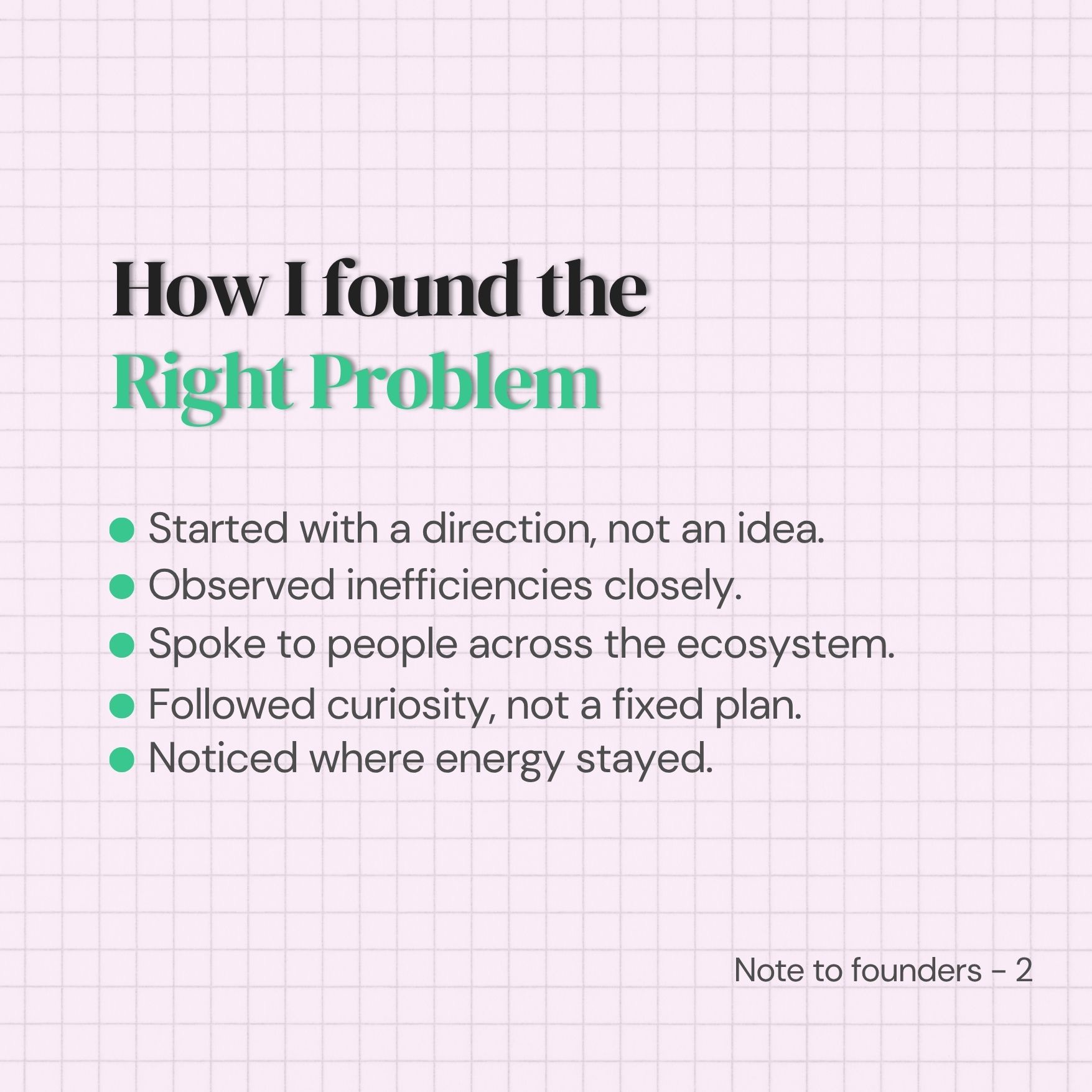
And that is how it began. Not with a clear idea or a defined plan, but with a series of small observations, conversations, and shifts in direction.
So if you are expecting clarity at the beginning, you may be disappointed.
Most of the time, it looks like this instead—
a starting point,
a question that bothers you,
and a willingness to follow it a little longer than most people would.
More soon,
Shanti