


Dear Founder Self,
If there is one decision that will shape your journey more than almost anything else, it is this one—who you choose to build with.
Over time, I have come to realise that many startups do not fail because the market was not large enough or because capital was unavailable. A significant number of them struggle because of co-founder conflict. Not necessarily because something dramatic went wrong, but because alignment slowly breaks down. And when that happens, it is very difficult to recover.
When I started building, I knew one thing quite early. I did not want to do it alone. Not because I could not, but because I understood that I needed someone to think with, to challenge me, and to share the journey with. Building a company can get lonely, and having someone at the same level changes how you navigate that.
What I did not have was a clear plan for how to find that person.
Finding a co-founder without a plan
At that time, I was still validating the idea and meeting a wide range of people—investors, operators, anyone who was willing to spend time understanding what I was trying to build. Most of these conversations would end in a similar way, with someone asking how they could help. And almost every time, my answer was the same: I am looking for a co-founder.
I must have repeated this across dozens of conversations over several months. It was not a strategy as much as it was clarity. I knew what I needed, and I said it out loud consistently. That is eventually how I was introduced to my co-founder.
There is no perfect starting point
A lot of founders prefer to start with someone they already know well—a friend, a colleague, someone they are comfortable with. And that works in many cases. But I have also seen conflicts play out across all these patterns. Friends fall out, colleagues misalign, and even strong professional partnerships can struggle when the pressure of building sets in.
In many ways, a co-founder relationship is closer to a long-term partnership than a purely professional arrangement. Over time, both people evolve. Sometimes you grow in the same direction, and sometimes you do not. Those differences are not always visible in the beginning.
So what should you really look for?
The first thing is simple, but often underestimated. You should genuinely like the person. You will end up spending more time with your co-founder than with almost anyone else during the early years. If the relationship is purely functional, it becomes difficult to sustain over time.
During one of my conversations with Sanjiv Bhikchandani, Founder of Infoedge, he told me something that has stayed forever. This was around hiring and managing teams - व्यवहार पहले, व्यापार बाद में।
Attitude comes first. Then comes skill and business acumen.
Respect and complementarity
The second is respect. You have to believe that the other person brings something meaningful to the table—something you do not have. This is where complementarity becomes important. Good co-founders are not identical. They bring different strengths, think differently, and often approach problems from different angles. When that difference is understood and valued, it becomes a strength. When it is not, it becomes friction.
Alignment over time
Beyond this, there is a deeper layer that is harder to evaluate but equally important. Do both of you see the journey in a similar way? Are you aligned on what you are trying to build and how long you are willing to stay with it? Because over time, roles will evolve. One of you may take on the CEO role, which comes with more visibility. If there is underlying competitiveness or lack of clarity, it tends to surface at that stage.
The outcome may look similar from the outside. The experience of getting there is very different.
From the outside vs from within
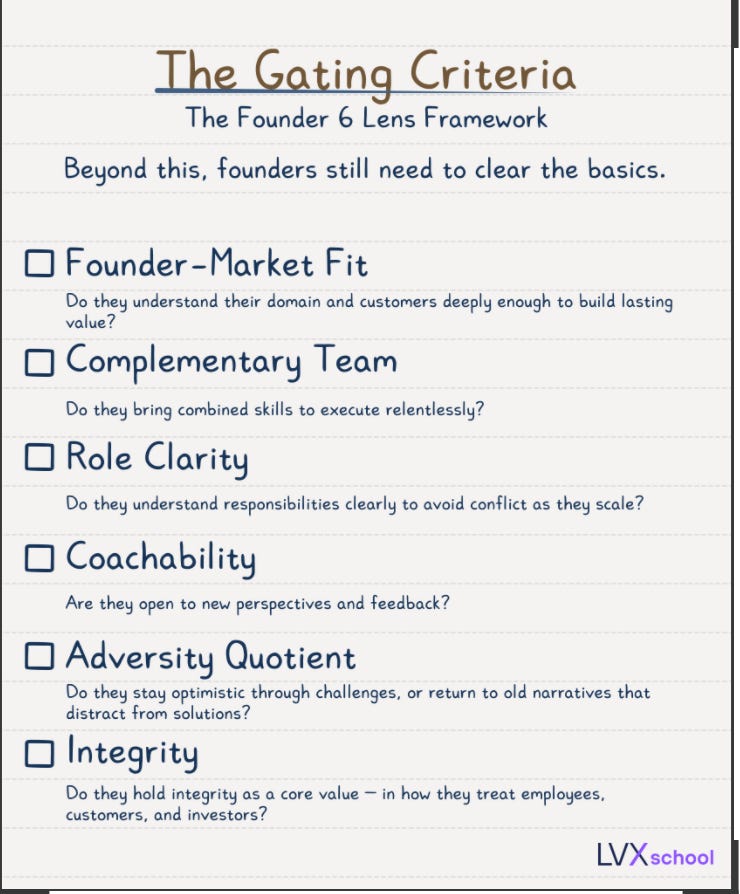
When I look at this from an investor lens, the pattern is very clear. Over time, you begin to see how often outcomes are shaped not just by the idea, but by the people building it and how they work with each other. I wrote about this in detail in my earlier post, from an investor lens. Certainly worth revisiting.
But when you look at it from the founder’s side, it does not feel like a pattern. It feels personal. It is about conversations that do not happen, expectations that are not articulated, and small misalignments that grow over time.
In my own journey, I have been fortunate. Sanjay and I have stayed the course. But that has not happened by default. It has required effort, communication, and a willingness to work through differences when they arise.
If you are at this stage, it is worth taking the time to be deliberate about this decision. Be clear about what you need, say it out loud, and keep looking. And when you do find someone, spend time understanding not just how they think when things are going well, but how they respond when things are uncertain.
Because that is where the real test lies.
More soon,
Shanti
Resharing the Earlier post summary here
what are you takes on having spouse as a co-founder? how do you know its for you as a couple and how do you know it aligns for long term w/o jeopardizing the marriage angle?