


After the last post, many of you might be wondering why we now went straight into how much to raise? I have written a lot about how investors evaluate, and how as a founder you should prepare your pitch deck for fundraise. Hence we will jump straight into what most first time founders fundraising struggle with: “How much should I raise?”
It sounds like a straightforward question. It is not.
I often hear founders say, “We want to raise ₹5 crore,” before they have really worked through what that money is meant to accomplish.
The number comes first. The reason comes later.
I think it should be the other way around.
Start with the milestone
The better question is: “What are the metrics my business should achieve for the next 18-24 months, and how much capital do I need to raise to achieve those metrics?”
Maybe it is reaching ₹5 crore in annual revenue. Maybe it is getting to product-market fit, proving repeat purchase, reaching a certain number of paying customers, completing a manufacturing facility, getting regulatory approval, or demonstrating that a technology works at commercial scale.
The milestone will look different for every business. Once you know the milestone, you can work backwards.
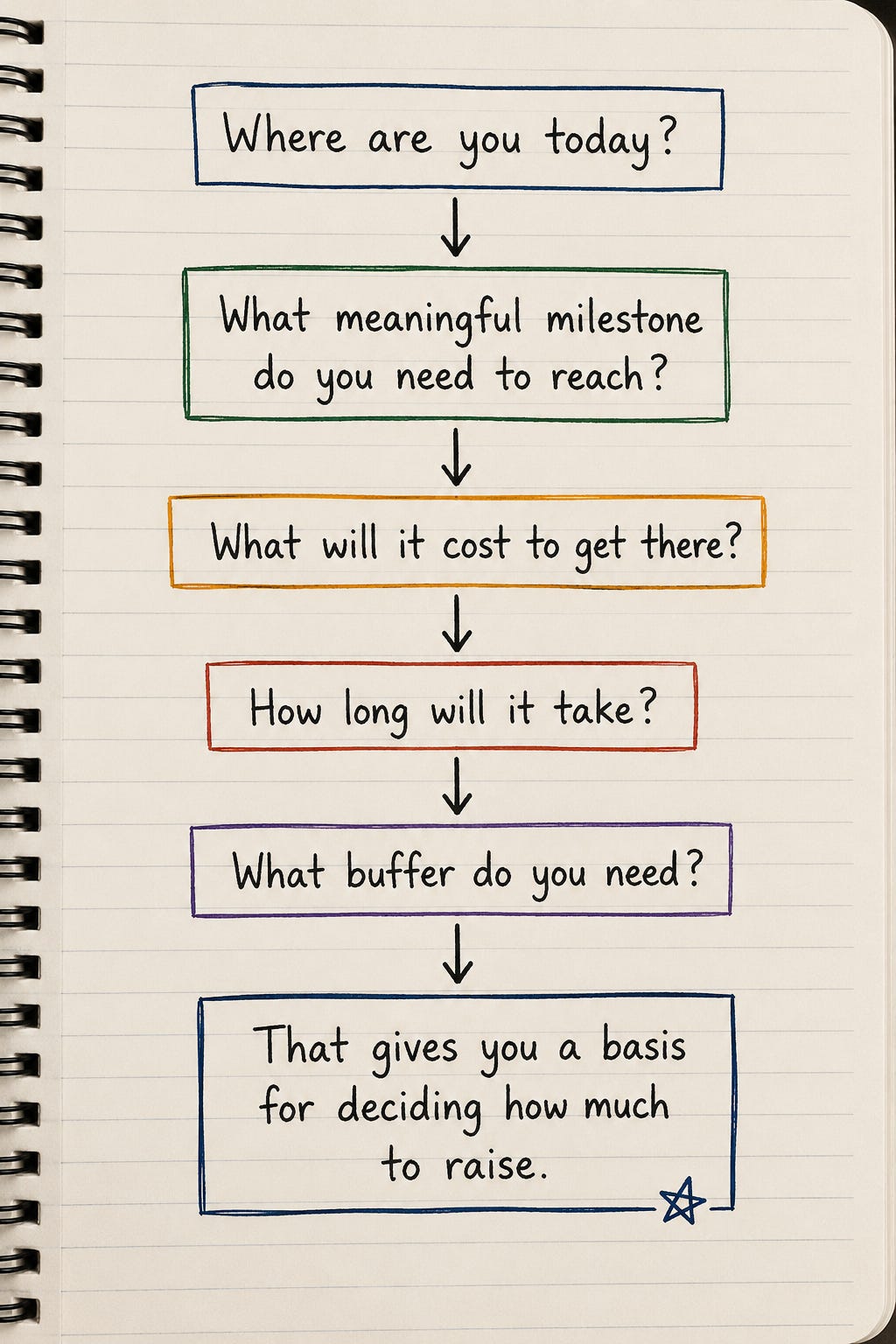
This sounds obvious, but it changes the conversation completely.
You are no longer raising money because you think ₹5 crore sounds like the right size of a round. You are raising because you have a clear view of what the capital needs to achieve.
The mistake is raising for runway alone
Runway is important. You need enough cash to give yourself time to build the business without constantly worrying about the bank balance.
But I would be careful about making “18 months of runway” the entire fundraising strategy.
Eighteen months of what?
If you raise ₹3 crore and spend it slowly for 18 months without materially changing the business, you may simply have bought yourself 18 months.
The better question is:
What should the company look like at the end of those 18 months?
That is the difference between raising money to survive and raising money to create value.
Don’t raise enough money to survive. Raise enough to reach the next meaningful inflection point.
Your milestone depends on the stage and sector - there is no one standard answer
This is where I think founders need to be careful with benchmarks. There is no single definition of “traction” that applies to every startup.
A SaaS company may need to demonstrate recurring revenue, retention and efficient customer acquisition.
A D2C company may need to demonstrate repeat purchase, contribution margins and a scalable acquisition engine.
A fintech company may need to show transaction volumes, customer engagement, credit performance or assets under management.
A DeepTech company may still be pre-revenue while its most important evidence is a successful pilot, a commercial contract, a large LOI, regulatory progress or technical validation. A deep tech startup is typically measured in terms of TRL (Technology-Readiness-Level), which is a good benchmark while building the execution plan.
The stage matters too.
What is impressive at Seed may be expected by Series A. What is an appropriate milestone for one sector may be almost irrelevant in another.
This is why I prefer to think about benchmarks as reference points, not targets handed down from above. They can only be directional in helping you plan as close. to what your own sector benchmarks could be.
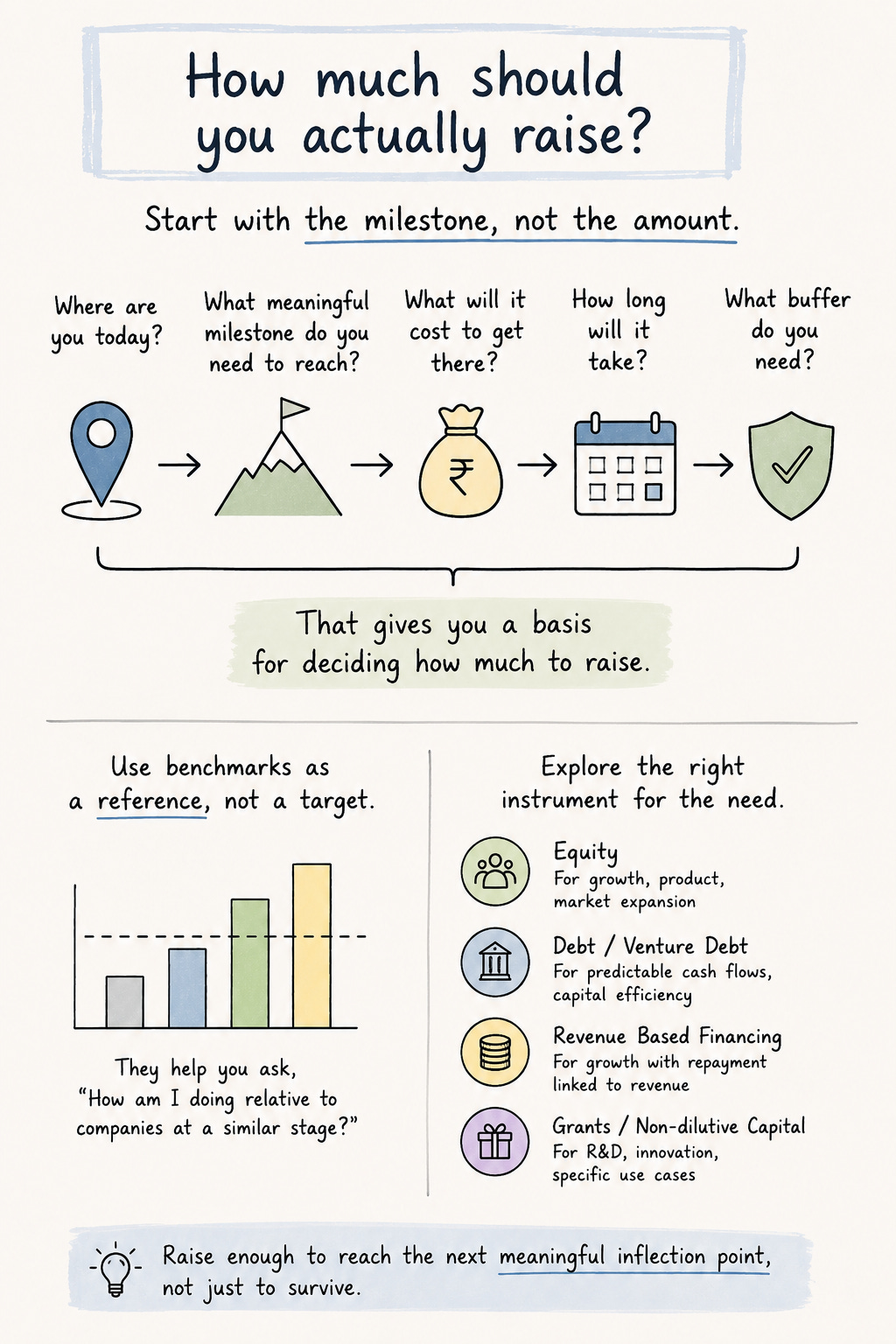
They help you ask, “How am I doing relative to companies at a similar stage?” They should not replace your understanding of your own business.
So how much should you keep as a buffer?
In all my years, I have rarely seen a startup get this right. Not because founders don’t know, but because there are uncertainties when it comes to building a business. There could be a surprise on travel, hiring could take longer, and product development almost never stays on schedule. Besides this, there could be things outside your control - like a geo political situation developing, or market sentiment dampening. Sometimes the round takes so long to close that you have already lost time, and it might require the business to accelerate in order to catch up.
Only very occasionally does the business outperform to numbers projected.
So I would not build a fundraising plan that assumes everything will go according to the spreadsheet. As a founder, you need enough room to absorb some of that uncertainty. I generally like to keep this around 20% buffer on the total amount.
But there is an equally important point on the other side:
Do not raise more simply because someone is willing to give you more.
A larger round can look attractive. More cash in the bank can feel like safety. But more capital also means more dilution, more expectations and, usually, a higher bar for the next round.
The right question is not: “How much can I raise?”
It is: “How much capital will help me build a meaningfully stronger company before I need to raise again?”
That is a very different question.
One exercise I would do before going to investors
My hack on this is to do a simple exercise. Build a revenue and cost projection for the next 18-24 months. Keep it conservative and do not over project revenues, and cut costs. Take the negative balance and add a 20% buffer. That would indicate how much you should raise.
When you build the costs, remember to include all costs (any licenses needed to build the competitive edge, negotiations time with distribution partners, hiring costs, marketing and technology). I would also recommend to hire or contract a professional chartered accountant to help you build the plan. Trying to save on accounting costs could result in the business absorbing a higher cost, if not done right. To this, dd a reasonable buffer.
That gives you the beginning of your fundraising number.
The number should come out of the plan, not the other way around.
And this is where benchmarks can help
At LVX, we have been building a benchmark framework across sectors and stages because founders often ask a very practical question:
“What does good look like at my stage?”
The answer is rarely one number.
It depends on what you are building, where you are in the journey and what investors are likely to expect at the next stage.
So for this post, I want to make the benchmark framework useful rather than simply publish another table of numbers. If you are a founder and want to know what the relevant benchmarks look like for your company, comment on this post with “Startup Name — Sector — Stage”
For example:
Acme — SaaS — Seed
I will DM you the relevant benchmark data.
The intention of benchmarks is not to tell you what your company should look like. It is to give you a reference point so that you can make a better decision about what you need to achieve, and therefore how much capital you actually need.
This being the second post is also not incidental. How much to raise is the most important conversation you need to have with your team, and with your co-founders. In this post, I have only talked about equity raise. In many startups, I see founders raising equity to fund working capital or capital expenditure. In those cases, you should at least explore whether another source of capital makes more sense — debt, venture debt, revenue-based financing or working capital financing.
The right question is not always “How much equity should I raise?”
Sometimes the better question is:
“What is the right kind of capital for what I am trying to achieve?”
We will get into that as we continue the series. For now, start with the numbers!
Have fun with them. This is just the start of an interesting task at hand.
Signing off,
Shanti
#TheFirstRaise #Fundraising #Founders #Startups #VentureCapital
Absolutely love the simplicity and clarity in your posts.
Mindful Planner - Events - Seed