


Dear Founder Self,
Keep the passion and the conviction when you start something of your own. That is the real differentiator - never feel like this needs validation, and is of lesser importance.
I had four founder calls this week, and by the end of them, I found myself struggling to remember which founder had said what. Different sectors, different cities, different products. Yet the conversations had a strangely familiar rhythm. The deck they presented was smooth, polished and complete. TAM looked very large - and surprisingly all decks had the same color coding and font.
A year ago, this would probably have impressed me. This week, it made me pause.
So I did something simple. I asked each founder the same question three different ways, partly out of curiosity and partly to test my own instinct. Two founders got better with every answer. The responses became more refined, more coherent and more polished each time.
The other two became slightly less polished. There were pauses. A few contradictions. One founder even changed her mind halfway through an answer and admitted that she was still figuring it out.
Oddly enough, I found myself trusting the latter more.
I have been thinking about those conversations ever since, because I suspect they capture something much larger about the moment we are living through.
When I started building LetsVenture in 2015, the very act of building a company meant something entirely different. We wrote product specs, hired engineers, waited through development cycles and spent months creating something that customers could finally engage with. We raised capital not merely to grow, but to buy ourselves time, because time was the one resource we never seemed to have enough of.
Founders beginning their journeys today inhabit a very different world. What took us months can now happen in weeks. Prototypes can be built over weekends. Customer feedback can be incorporated almost instantly. The barriers to experimentation have fallen in ways that would have seemed impossible a decade ago.
I do not say this with nostalgia. If these tools had existed when we started, I would have embraced them wholeheartedly. Most founders I know would have done exactly the same.
But as I watch this shift unfold, I find myself wondering whether we are beginning to confuse speed with conviction.
A few weeks back, Shekhar Kirani, Partner at Accel India had written something similar. He spoke about founders using AI to create beautifully polished pitch decks before they had fully worked through what they themselves believed. The phrase he used was “vibe-generating,” and it immediately resonated with me because it gave language to something I had already been observing.
The challenge is not that founders are using AI. The challenge arises when AI begins to write the story before the founder has lived enough of the journey to own that story.
After all, AI knows what a successful pitch generally looks like. It understands patterns. It can identify the language, the structure and the narratives that have worked before.
But your company is not meant to be an average of everything that has worked in the past. The one thing AI cannot tell you is why this particular problem matters enough for you to dedicate years of your life to solving it.
That answer still has to come from you.
Over the last year, I have written about the 5 Core C’s framework that shapes how I evaluate founders and companies. The complete framework is available on my Substack at The PitchRoom, but two of those dimensions feel especially relevant in an AI-first world: Clarity and Capability.
Clarity is not about eloquence. It is about understanding a problem so deeply that you can explain it simply and respond to difficult questions without hiding behind jargon or prepared narratives.
Capability is not about ambition alone. It is about demonstrating, through action, that you are already building, already learning and already earning the right to solve that problem.
Technology can help you communicate both of these more effectively. It cannot create them for you.
I often think about the months before LetsVenture became a company. For nearly nine months, there was nothing tangible to build. There were only conversations. Conversations with founders who struggled to access investors, and conversations with investors who struggled to discover opportunities they trusted.
Somewhere during those months, a single sentence became clear to me.
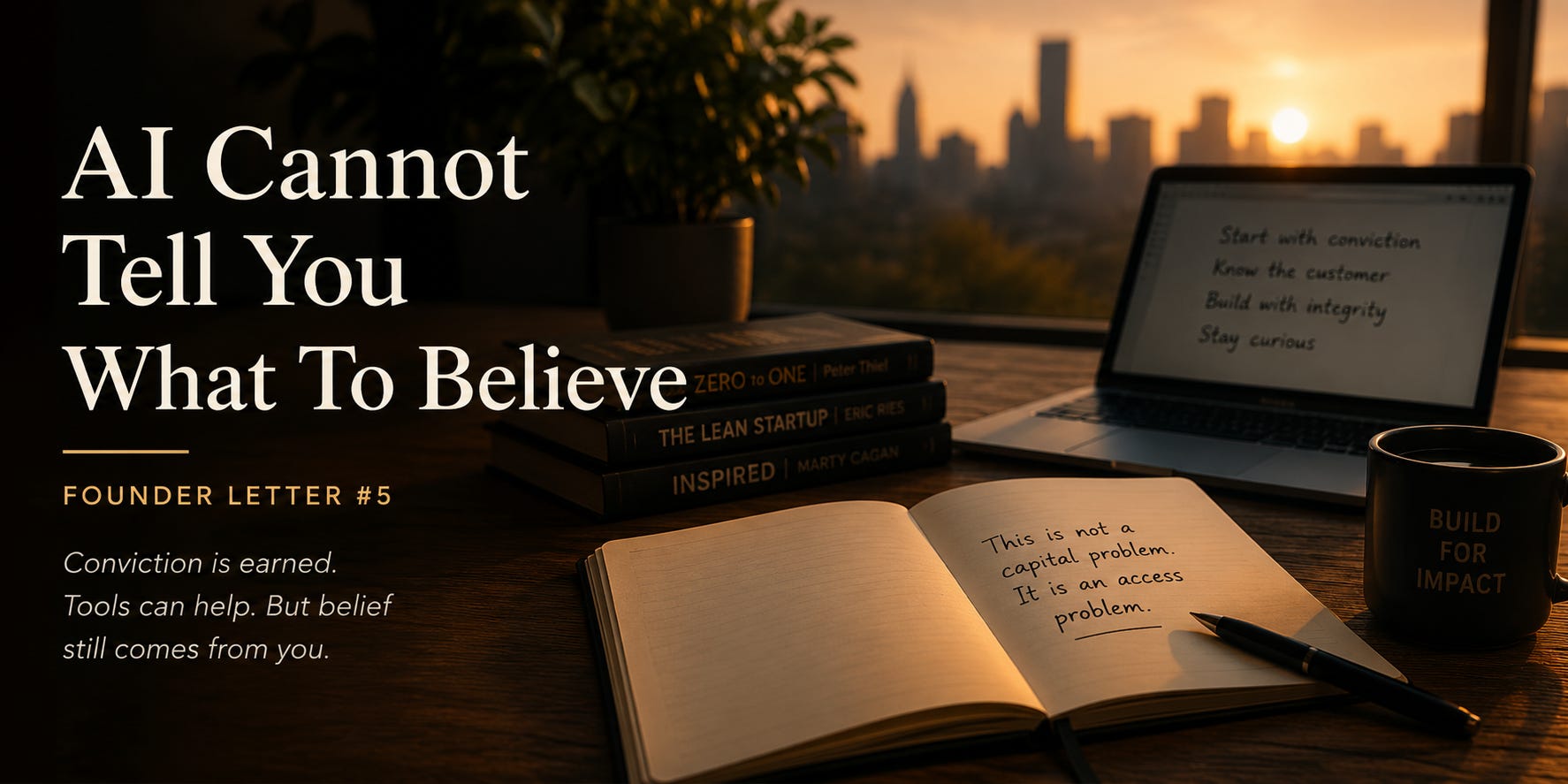
This was not a capital problem. It was an access problem.
Everything else followed from that conviction. The platform, the technology, the fundraising and the team all came later.
No tool could have compressed that journey because the work itself was deeply human. It required listening, observing and arriving at a belief that felt true enough to build an entire company around.
I increasingly see two kinds of founders in today’s world.
The Builder founder: There are developer-founders who possess both domain understanding and technical capability. For them, AI has changed the economics of building in extraordinary ways. They can move faster, experiment more freely and reach customers with remarkable efficiency.
The Domain Founder: Then there are domain experts who understand their customers intimately but still need teams to translate that understanding into products. AI helps them too, but not in the transformative way that headlines often suggest.
Neither approach is superior. They are simply different journeys.
Yet much of the current conversation around AI assumes that every founder is a developer armed with a laptop and a weekend project. Most founders I meet are not, and perhaps that is perfectly fine.
The deeper truth, at least from where I sit, is that the moat has always been people.
The founders I continue to believe in are rarely the ones with the most polished presentations or the most sophisticated technical stacks. They are the people who understand their customers with unusual depth, who adapt as technology changes around them, and who can explain with conviction why they are uniquely positioned to solve a particular problem.
Trust remains a human endeavour. Relationships remain a human endeavour.
The instinct that tells you something is not quite right in a room, long before the data confirms it, remains deeply human.
AI can help with research. It can accelerate prototyping. It can optimise processes and reduce the cost of experimentation. What AI cannot do is tell you what to believe.
It cannot give you the conviction that customers will pay for what you are building. It cannot create the relationships that sustain a company over decades. It cannot write the one sentence that explains why your company deserves to exist.
That sentence still belongs entirely to you.
And so I find myself returning to those four founder calls.
The people I trusted most were not necessarily the ones with the perfect answers. They were the ones who paused, reflected and occasionally admitted that they were still learning. Perhaps that is what conviction looks like in practice. Not certainty, but ownership. Not polish, but depth.
The tools available to founders have changed dramatically.
So — what do you actually hand to AI?
I’ve been asking myself this all week, mostly because I keep meeting founders who are either afraid of AI or far too relaxed around it, and both postures miss the point. The question was never whether. It’s which parts. Here’s the honest breakdown, over coffee, if a founder asked me directly.
You can outsource:
The first high-level research around your idea
A quick prototype, built with the UI you actually want, fast enough to put in front of real users
Getting that early user feedback
Testing and optimizing, once you know what you’re testing for
You cannot outsource:
Your own drive — why you, specifically, want to build this
The conviction that your customer will actually pay you for this, and why
The belief that this is the biggest problem worth solving, stated in your own words
Interpersonal skills — the actual relationship with the people who need to trust you
The instinct for knowing something is wrong in the room, before AI or any dashboard catches up to it
Or maybe I’m wrong about all of it. Social networking felt strange too, once. I remember people joining Snapchat mostly to test it out, half-amused that there was suddenly a place to talk to a dozen friends at the same time — nobody predicted what that would become. AI might open up behaviors in people that none of us have a name for yet. Time will tell.
More soon,
Shanti