

In 2012, when I was working on the idea of LetsVenture, it all began with one founder meeting, followed by an insight that seemed to repeat itself every time I met founders. This founder had been fundraising for many months — travelling, setting up one-on-one meetings, and doing everything possible to persuade investors. Yet the funding was not closing. The frustration was visible
As a founder, it was hard to find the right investor. By “right”, I meant someone who would understand what you were building, be empathetic to the journey, and say yes to investing. At the same time, as an investor it was equally challenging to meet the right founder. The discovery problem was real on both sides.
More than a decade later, the problem still exists. Over the years, as LetsVenture evolved into a platform enabling these handshakes, I realised something interesting.
Technology can solve many aspects of discovery, matching, and access. But it cannot easily solve for the human expectations and emotions on both sides of the table.
Over time I have noticed a few recurring patterns. These are not mistakes as much as interpretations — moments where founders and investors are looking at the same conversation but drawing very different conclusions.
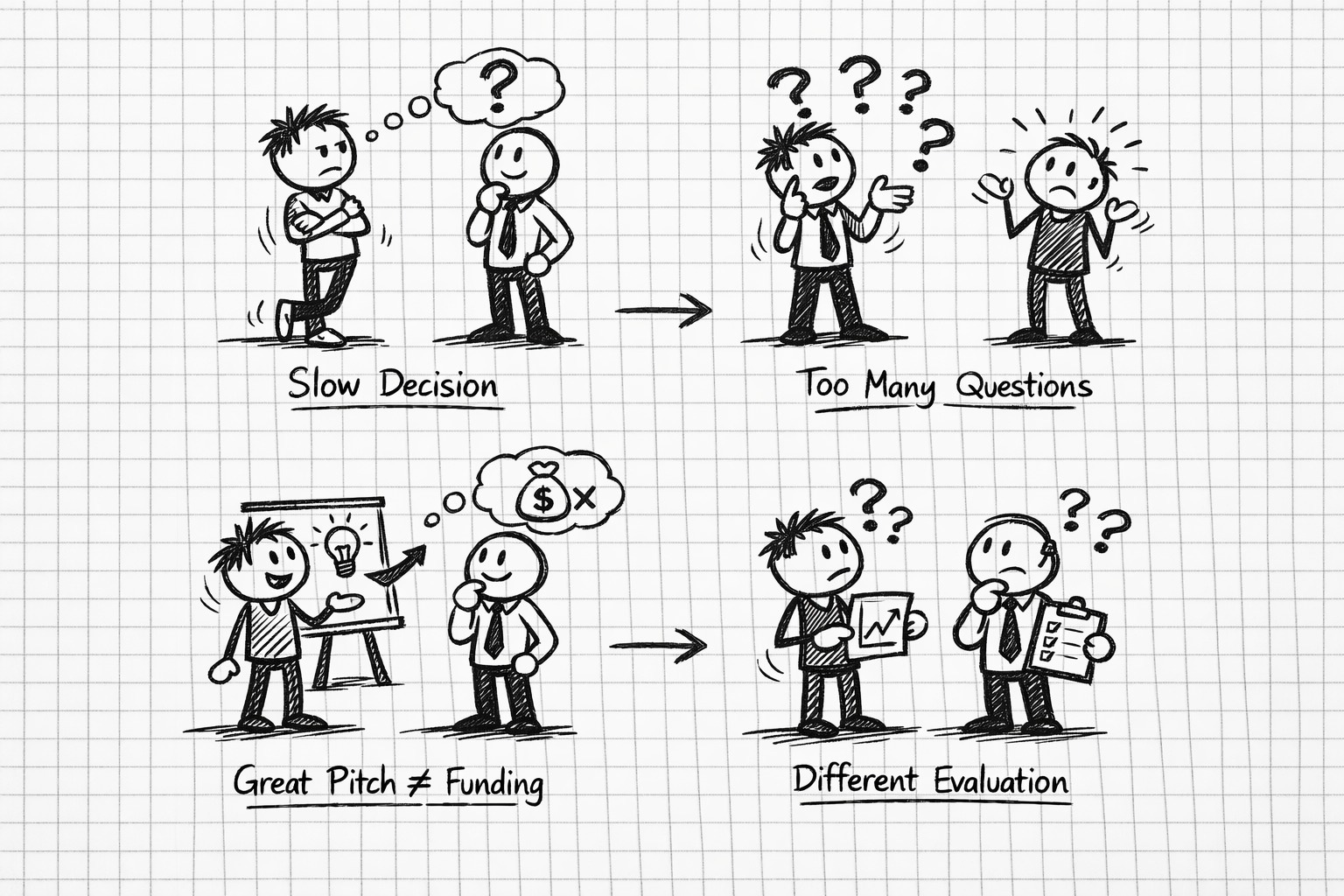
The first misunderstanding often begins when founders feel that the investor is taking too long to decide.
When investors go quiet after a meeting, founders often assume the answer is no. As founders, we are so eager, we are trying to read body language, look beyond the words and see if we can detect a ‘friendly yes’.
In my experience, usually a NO is more immediate than a committed YES.
Early-stage investors rarely make the final decision in a single meeting. They may be comparing opportunities, thinking through the market, or discussing the company internally with friends and people they trust in investing. Occasionally they simply want to observe how the founder executes over the next few weeks.
As founders we are seeking momentum and silence can feel discouraging. But in many cases it could also mean the investor is still forming a view. Also, unlike a fund or an institution, an individual does not have pressure to deploy capital. They maybe busy at personal events, get caught at work or just might not be in a position to decide quickly.
The second misunderstanding appears when questions begin.
When investors ask many questions, founders sometimes interpret that as skepticism. In reality, thoughtful investors are often trying to understand how the founder thinks.
How the founder responds matters more. Two founders may give similar answers, but the clarity of thinking behind those answers can feel very different.
Early-stage investing is largely about evaluating how someone navigates uncertainty. Questions are often the only way to see that thinking process.
The third misunderstanding is assuming that a great presentation leads to the investment.
A VC once told me that one of the joys of investing is seeing how creatively founders tell their story. It is not necessarily about the format of the presentation. Today founders are fundraising in a very different environment. With a single prompt into an AI tool, investors can generate multiple observations about a pitch deck within minutes. The investors have all the tools to evaluate information.
Don’t get me wrong - a strong presentation certainly helps. It shows structure, answers questions ahead and shows clarity. But conviction rarely comes from the slides alone. Besides the AI tools, most investors have sat through extraordinary presentations made by some of the smartest people.
What matters more is what happens after the slides. How the founder explains the market without a script. How they respond when challenged. How deeply they understand the problem they are solving.
A great story can open the door. But conviction usually builds in the unscripted parts of the conversation.
The fourth — and perhaps the most important — misunderstanding is assuming all Investors are evaluating the same thing
There is so much information around fundraising checklists today that founders often assume investors are following a common checklist.
Each investor brings their own lens.
Some care deeply about founder resilience. Others focus on market size. Some are thinking about timing, while others are evaluating how the company fits into their portfolio.
This is why one investor may pass while another invests enthusiastically.
Understanding this can make fundraising feel less like judgment and more like alignment.
Lastly A “no” is often about timing, not belief
One of the hardest realities of early-stage investing is that investors say no even when they like the founder.
The company may be slightly too early. The market may still be forming. Or the investor may feel that they cannot add meaningful value at that stage.
Years later, many investors look back and realise that companies they passed on eventually succeeded. It is simply the nature of investing under uncertainty.
As founders, our job is to stay true to the problem we are solving, and ensure we show up to market feedback and customers. Before you start officially fundraising, take time to talk to people who might be potential investors to take feedback early and get perspective. This way, when you officially go fundraising, you are more aware, and better prepared. Over time I have realised that fundraising is rarely about convincing everyone in the room.
It is about finding the few people who see the problem in the same way you do.
The rest of the meetings, the questions, the delays and even the rejections are simply part of that search.
Enjoy this sketch - hope it encapsulates all I have tried to convey :)
I always say that you can't sell a blue motorcycle to someone looking for a red colour car, that too an electric.
Knowing what the investor wants is definitely not a case of fitting your ask, but often times, walking away from the conversation with the one looking for the red car, if you have a blue motorcycle that's running on petrol.
Great perspectives. Really helpful. The point on 'what happens unscripted' is worth in gold. That's why real conviction matters. Thanks for sharing.