


We talked earlier about idea and intent, and how large markets are often a prerequisite for venture success. Like in most things in investing, there are rules — and there are edge cases. Rules help us build frameworks. But investing, in the end, is also instinct — a mix of pattern recognition, conviction, and reading people.
So what happens when you meet a team that projects its total addressable market — its TAM — as ₹10 crore? Would you still invest at the idea stage?
I am opening up my investing portfolio and playbook because real learning often happens when we look back at our own patterns. Today we will discuss one of my early investments in OnlineRTI and draw some interesting lessons around idea and intent and evaluating TAM.
(If you want a primer on TAM, read my post on the 3 Idiots here)
2014: We had just launched LetsVenture. I was introduced to Pradeep through a friend. He had completed his masters from IIT Bombay, and had quit an MNC job paying 40L per annum (this was 2014!) to found Online RTI. What he wanted to build wasn’t glamorous or “fundable” by conventional standards — he wanted to make it easier for Indians to file Right to Information (RTI) applications online.
For context, in 2014, filing an RTI meant drafting a legal letter, identifying the right government officer, buying a postal order, and sending it by speed post. The process was outdated, bureaucratic, and painful. Millions wanted information from government departments, but very few had the time or knowledge to navigate the process.
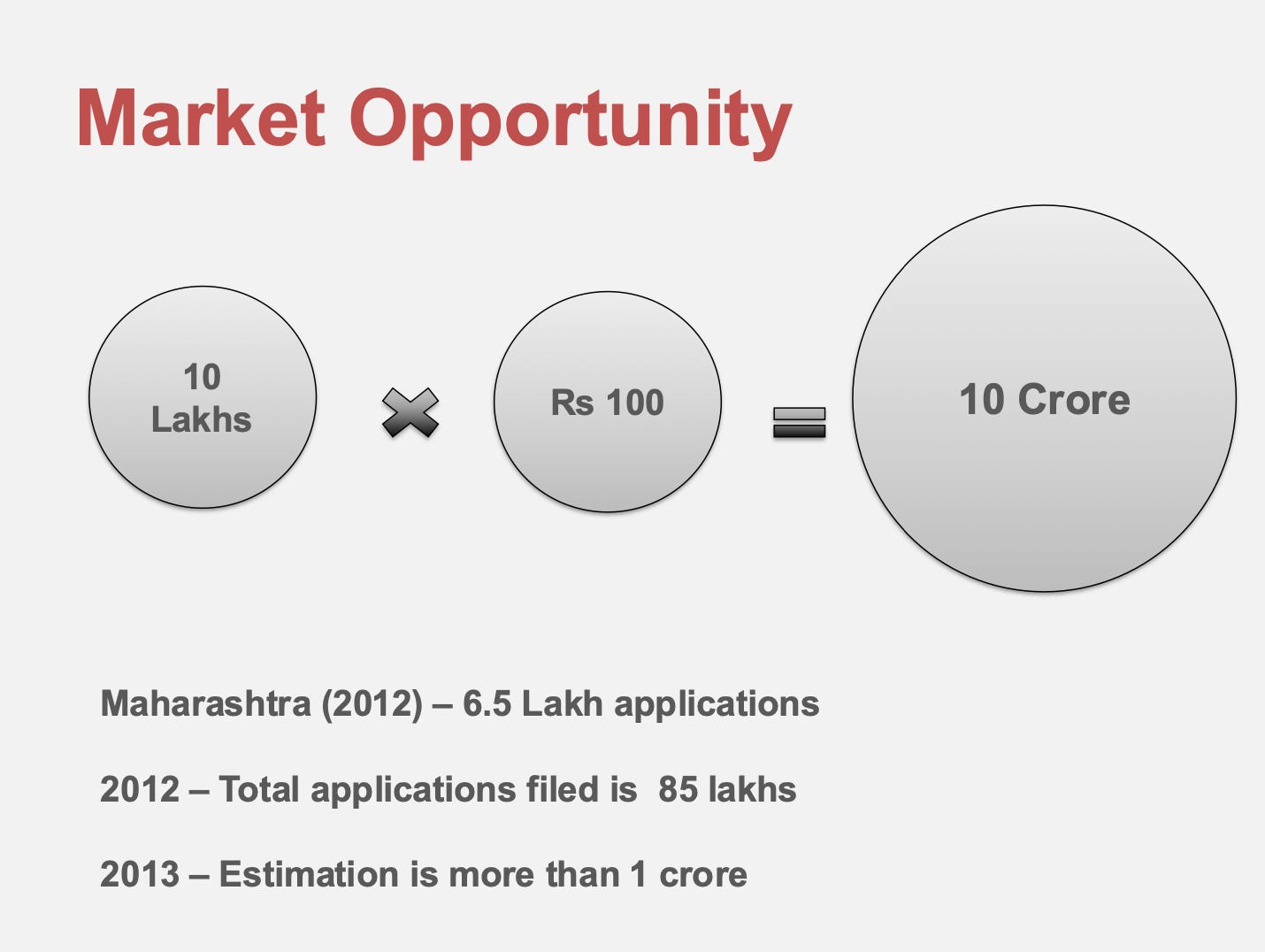
When Pradeep and his co-founder Vinoth pitched OnlineRTI, their product was beautifully simple — three steps to file an RTI: draft, pay, and send. The problem was clear, the solution elegant. But the number on the slide made everyone pause: TAM: ₹10 crore.
That was the market size they projected for their business. Ten crore rupees. Not ten billion. No hockey-stick charts, no exaggerated assumptions.
The Case for Clarity and Capability
In my 5 + 2 Framework, the signals — Clarity, Capability — are what I always look for before a cheque is written. OnlineRTI was a perfect example of this.
The founders had clarity. They understood the problem deeply and could explain it in simple language. There was no jargon, no hand-waving. Just a clear articulation of what was broken and how they planned to fix it.
They had capability. Both founders were strong technologists who knew how to build, run operations, and listen to users. They didn’t need to hire expensive talent to get started. They had demonstrated intent by their willingness to be uncomfortable and leave behind a good job.
So yes, the market looked small, but the founders didn’t.
Since LetsVenture was in its early days, I was deeply involved in most transactions. I was deeply involved in the fundraise for Online RTI. Most of the investors who came in were Indians living abroad — professionals who wanted to participate in India’s growth story and cared about impact. Many of them were first-time angels. I remember long conversations explaining what angel investing meant — about conviction and patience.
After the round, I joined their board and stayed close. I helped with interviews, reviewed plans, made intros, and occasionally just listened. The journey was slow, but it was steady. The founders never overpromised. They just kept building.
The key takeaway is as an investor, once invested, it is great to contribute to founders where they ask for help.
Coachability of founders becomes important, and sometimes this trait is difiicult to assess at the time of investing. The only way to assess is by active conversations.
So what happened? Did the TAM grow? Or did the founders expand it?
The Myth of TAM
If you look closely at early-stage investing, you realise something simple but fundamental: TAM is not a verdict. It’s a hypothesis.
At the earliest stage, TAM isn’t about accuracy — it’s about direction. It helps you ask: Is there a clear need, and is the market big enough to care?
The problem begins when investors treat TAM as a limit, rather than a starting point.
When Small Markets Become Big Opportunities
OnlineRTI didn’t invent a new market — they organised an old one.
They took a fragmented, offline process and built a bridge for citizens to access information easily. Most importantly, they listened to what the market was telling them.
A few years in, they started getting requests from companies — not citizens. Businesses wanted access to RTI-based data for verification and compliance. Court records were very fragmented in India and a crime check in one state did not show the details in another state.
With an incident with a woman passenger, Uber reached out, asking if RTI data could be used for background checks of the driver across states.
As a founder, this is when first principles help. If a large customer is asking for information they find challenging to locate - it shows a gap, waiting to be addressed.
The founders realised the real opportunity wasn’t in filing RTIs. It was in the infrastructure they had quietly built — the ability to access and verify public data at scale.
That insight led to the creation of CrimeCheck, a B2B platform offering litigation history reports to lenders and background verification companies — much like credit history reports, but for legal cases. Same DNA, same founders, new direction.
This is what great founders do — they don’t just serve demand, they shape it.
A small TAM on paper became a much larger market in practice because of the strength of execution and the ability to listen.
And through all of this, the team never lost the emotional connect to their story. They believed in the problem, they built carefully, and their authenticity made people believe in them.
The Outcome
The pivot worked.
OnlineRTI evolved into CrimeCheck, which went on to be acquired by IDfy, (who was also a customer) one of India’s largest digital verification platforms.
The small civic-tech idea with a ₹10 crore TAM eventually became a company with a 10× exit for its early investors.
No viral moment. No hype. Just quiet progress, clear thinking, and deep execution.
This is why I always say — frameworks matter, but people matter more.
Markets grow, shrink, evolve. But founders — the right founders — expand the boundaries of what’s possible.
Sometimes, the market doesn’t grow. The founders do.
For fun, attached is the deck I had reviewed in 2014. Would you as an investor decide to invest?
Note: I have Pradeep’s permission to share this story. All information shared here has been approved by the founders.

Join The PitchRoom WhatsApp
A private learning space for founders, investors, and the startup curious.
No spam. Just real-world analysis, prompts, and frameworks.
Coming up next:
How do we calculate TAM as an investor?
This really resonated with me! The way you've captured that moment of doubt when investors question your TAM is so relatable. What I love most is how you didn't just defend your position - you actually went back, did the homework, and came out with deeper conviction about the niche you're serving.
That realization about depth over breadth is gold. So many founders have felt that pressure to go broad to satisfy investors, but your point about owning a smaller market completely before expanding is exactly right. Sometimes the "small" TAM is actually the foundation of something much bigger.
Also appreciate the honesty about the emotional rollercoaster of fundraising. The self-doubt is real, but so is the clarity that comes from working through it. Thanks for sharing this journey so openly!
This is an Excellent post and case study, a TAM with Rs. 10 Crore, even no investors will listen to you, but the OnlineRTI so far has build a great company. At the end of the day founders realistic assesment and visualisation of the problem statement and its realistic solution brings the success story.