


In the last post 2/12, we talked about how much you should raise. I want to begin this one by saying that the two questions are not separate. How much you raise and what you raise it at are decided by the same things: your sector, your stage, the benchmarks in your industry, and where you want to take the capital. Founders often treat valuation as a number they arrive at on their own and then defend. It rarely works that way.
Let us look at what actually decides it.
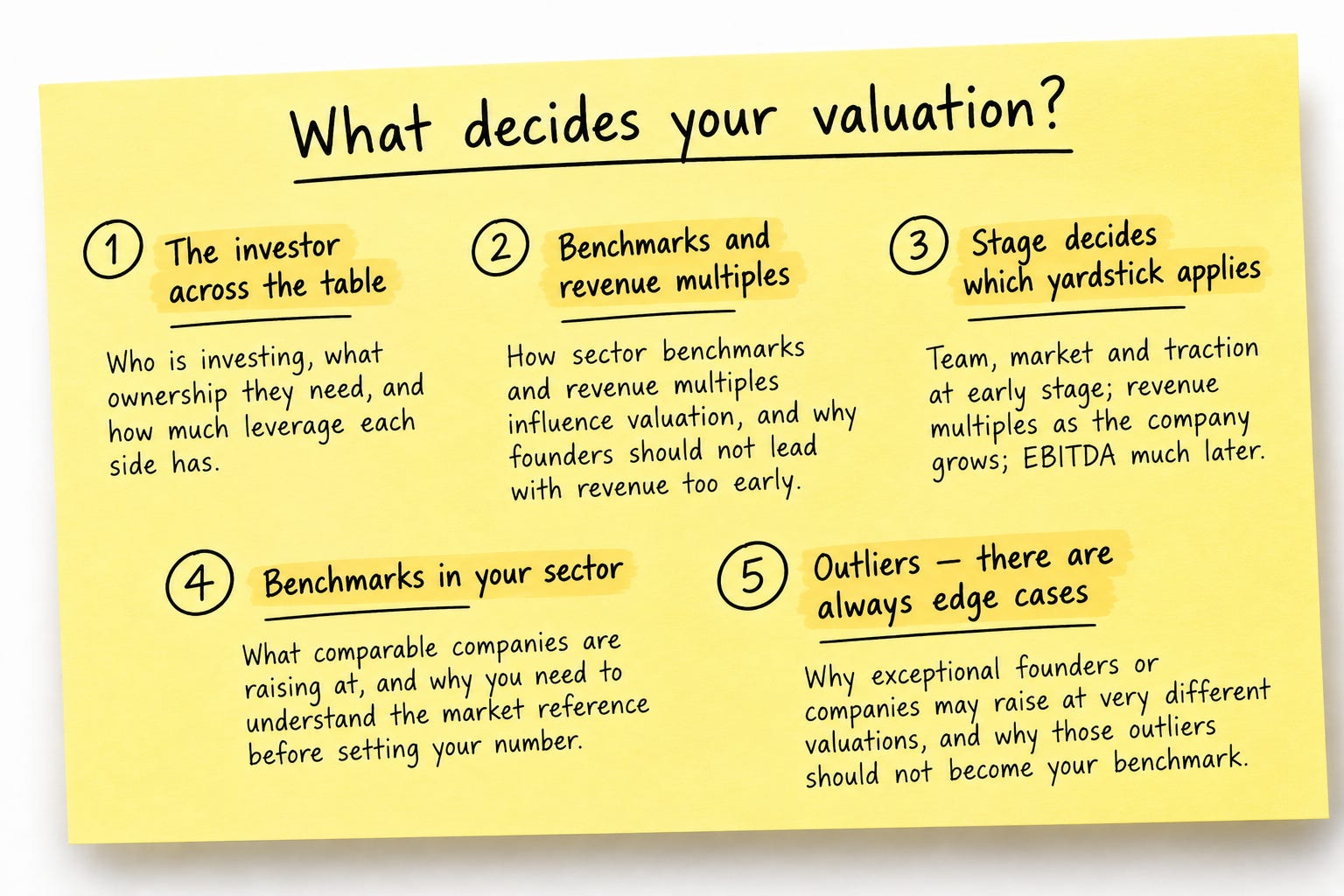
1. The investor across the table
Some investors, especially institutions, come in with an ownership target. They need to hold a certain percentage of your company at the end of the transaction, and that target matters more to them than the valuation itself. At times, they do not care what your valuation is at all.
Say an investor wants to hold 5%. The valuation then comes down to two things: how much money you need, and who has the stronger hand. If you already have revenues, or you are profitable, and you do not want to give away 5%, the investor who still wants that 5% now has to invest large capital - sometimes this gets structured as primary capital (that which gets invested into the company’s capital pool) and some that is structured as secondary (where the investor buys out existing shareholders). That is how the valuation gets decided. It is not always the spreadsheet. It is the negotiation between what they need to own and what you are willing to give.
So before you walk into the room, know who you are talking to. An angel, a fund with an ownership mandate, and a strategic investor will each arrive at your number in a different way.
2. Benchmarks and revenue multiples
Every sector has a revenue multiple that the market uses as a reference. When a company already has a revenue stream, valuation becomes easier to anchor because there is something real to multiply.
But this is where early founders misread the room. If you are too early in your life cycle and you lead with revenue and EBITDA, the investor can use those numbers to decide your valuation, and that can set a lower valuation number. Very early, your revenues may not be high because you may not yet have found the repeatable, scalable engine a company needs to build consistent revenue. You end up being priced on the weakest version of your business.
Talk about revenue when it tells your story. Not before.
3. Stage decides which yardstick applies
In the earlier posts, we spoke of three phases of a startup: early stage, growth stage, and pre-IPO. The yardstick changes with each.
At the early stage, you are valued on the team, the market and the signals of traction. At the growth stage, revenue multiples start to matter. EBITDA multiples should really not come into the conversation before a Series B, because those numbers need time to be refined and become consistent enough for an investor to rely on. If someone is applying an EBITDA multiple to your seed round, the yardstick is wrong for your stage.
4. What others in your sector are getting
There is also the market around you. When startups in your sector raise at certain valuations, an industry standard begins to form, and investors carry that reference into every conversation. You cannot ignore it. If your ask sits far above what comparable companies are getting, you will need a very clear reason why.
5. Outliers - there are always the edge cases
Everything above is the norm, and most startups fall within it. But every so often, one company stands apart. The founder has built and exited a business in the same space before, or was part of the early team at a company that grew very fast, or is simply a successful repeat founder. Their raise and their valuation tell a very different story, because investors are pricing the founder’s track record as much as the business.
It is useful to know these companies exist. It is dangerous to use them as your benchmark. If you anchor your valuation to an outlier without the outlier’s history, you will either struggle to close the round or close it at a number your next round cannot justify. That is a spiral, and it is very hard to get out of.
Know which one you are before you set your price.
Why the number matters so much: the entry price
Here is the part most founders underestimate. Your valuation sets the entry price for your investor, and that entry price decides what you have to become for them to make any money.
This is roughly the maths an investor does. They look at where your revenue is today and ask what it can realistically become in three or five years. They ask how big the market can get. Then they apply the multiple your sector is likely to command at that point, which gives them a possible exit valuation. The only question left is whether the company can exit at that number, given the price they enter at.
Let us take an illustrative example. A company has ₹5 crore in revenue today. The investor believes it can reach ₹100 crore in five years, and that the sector will value it at around five times revenue. That puts the exit at ₹500 crore. If the investor enters at a ₹50 crore valuation, that is a 10x return. If they enter at ₹150 crore, the same outcome is barely 3x, and that is before later rounds dilute them.
So the company is the same, the plan is the same, and the founder is the same, but the return is completely different. At ₹20 crore, the company needs to reach ₹200 crore to deliver 10x. At ₹150 crore, even a 5 to 7x return needs a ₹800 to ₹1,000 crore outcome, and 10x needs ₹1,500 crore.
This is why funds are more careful than founders expect, and why every change in the number matters to them. A fund does not need each company to work. It needs the fund as a whole to return money, and in venture, most of those returns come from a very small number of companies. That is the power law. Every company they back has to be capable of being one of those few. If your entry price means that even a great outcome only returns 3x, the investor cannot count you as one of them, however much they like you.
And then there is AI
Every couple of years, one sector breaks all of the maths. Valuations run far ahead of what any revenue projection can justify because investors are pricing the chance of a category-defining outcome rather than the business in front of them. Right now, that sector is AI.
If you are building in AI, you may well raise at a number the frameworks above would never give you. But understand what it is: It is a bet on the category as much as on you, and the next round will still ask whether your revenue has caught up with your price.
The higher you price the round, the higher the bar you set for yourself. A big number today feels like a win. But every rupee of valuation you take now is a promise about what the company will be worth later, and the next investor will hold you to it.
So, what is your company worth?
It is worth what the right investor will pay, at your stage, in your sector, for the amount you actually need. Work out the raise and the valuation together, not one after the other. Know who is across the table and what they need to own. And price the round so the next one is still possible.
The intent of writing this series is to get founders to think more deeply, understand the math before walking into an investor room. Hope this helps you when you have your next investor conversation.
Have fun building.
Warm Regards,
Shanti
Next in the series: Do you really know your pitch deck?